News sentiment, beside the news
The June piece was the news itself. News sentiment is how that coverage reads. Friday, 16 October, shows it on Microsoft and on the Fed, and then the numbers get a meaning.
Published

If you have already read Sugra News, you know the news we keep. The articles you can open. How loud the coverage was. Whether anyone outside the trade press noticed. That piece stands on its own.
This one is the reading that sits beside it. News sentiment. Once the story is in front of you, how does the coverage around it actually read? A definition is a poor way to meet that. A morning is better. Friday, 16 October, had two.
Microsoft
The news on Microsoft that morning was easy to name. Bloomberg reported that the UK competition watchdog had proposed tougher oversight of the company’s business software, on the view that its hold on that software makes it harder for customers to switch. CNA carried the same scrutiny. In the same hour the Hindustan Times carried a different story: Microsoft’s president, Brad Smith, warning that restrictions on H-1B visas and green cards could push technical talent out of the United States. All three ran before half past nine, UTC.
As titles, the hour sounds heavy.
What came back with the stories was a tone for the stored day. The average was -0.65. At 09:15 UTC the latest reading was -1.48. What those numbers mean is explained below. Some pieces in that same day reached about -7. The company was found under its registered name, Microsoft, not under the four letters of the ticker.
The Fed
The macro subject of the same Friday was the Federal Reserve. Reuters reported that Chair Kevin Warsh saw resilience in the US economy and would not give a path for rates. Through the day the wider coverage carried the rest of it: a warning about an AI shock, a pledge to contain inflation, and a note on financial-stability risk as investment rises.
News sentiment on his name, over the stored day ending Friday at 20:15 UTC, did not come back as one harsh number. The mass of the coverage sat around zero and a slight minus. A smaller pocket was harsher, around -4, with a few pieces further down.
Two subjects. The same kind of number. Before it can be useful, the number has to mean something.
What the numbers mean
The number is the balance of the wording in the coverage. Take the share of words with a positive cast, take the share with a negative cast, and subtract. Zero means the two shares are even. A minus means the negative share is larger. A plus means the positive share is larger.
The scale can run, in theory, from -100 to +100. Real coverage almost always sits between -10 and +10.
Near -10 is already a strongly negative piece.
Near +10 is strongly favorable.
On that ruler the Friday readings separate cleanly. -0.65 is a slight lean against Microsoft: less than one percentage point more negative wording than positive. You would not call the day a crisis. -1.48 is the same lean, a little stronger, still mild. -7 is a different object. That is a harsh piece, about seven points more negative than positive, an article written against its subject. Those patches were in the day. The average of -0.65 says they did not take it over.
The Fed uses the same ruler. A reading around zero to -1 is that slight lean. A pocket around -4 is a clearly adverse article, and it is still not the day. A heavy headline and a mild average can both be true. The stories tell you what was written. The sentiment tells you how hard the wider coverage took it.
Asking for it
A person asks in the assistant they already use, once Sugra MCP is connected. The question stays in ordinary words.
What is the news on Microsoft, and what is the news sentiment? Then the same for Fed Chair Warsh. Give me the headlines, the average tone, and tell me if any of the coverage was actually harsh.
The assistant returns the stories and the numbers on the ruler above.
A product asks Sugra API. The company call returns the headlines, the average, and the latest reading.
curl -sS -H "x-api-key: YOUR_API_KEY" "https://sugra.ai/api/v1/equities/MSFT/news-sentiment"What comes back, cut down to the tone:
{
  "symbol": "MSFT",
  "company_name": "MICROSOFT CORP",
  "timespan": "24h",
  "sentiment": {
    "average_tone": -0.6512,
    "latest_tone": -1.4802
  }
}
The subject call returns the distribution, so the slight lean and the harsh pocket stay visible on their own.
curl -sS -H "x-api-key: YOUR_API_KEY" "https://sugra.ai/api/v1/gdelt/sentiment?q=Warsh×pan=24h"Friday, held together
Microsoft closed Friday at 529.05. It had opened at 541.06. Thursday’s close was 539.44.
The titles from the morning are still in the room. A watchdog. Software that customers struggle to leave. A warning on visas and talent. A person who then sees 529.05 can take all of it as one hard day.
The sentiment keeps the two apart. An average of -0.65 is a slight lean. The 09:15 reading of -1.48 is that same lean, a little stronger. The patches near -7 were written, and they stayed patches. The shares moved further than the coverage did.
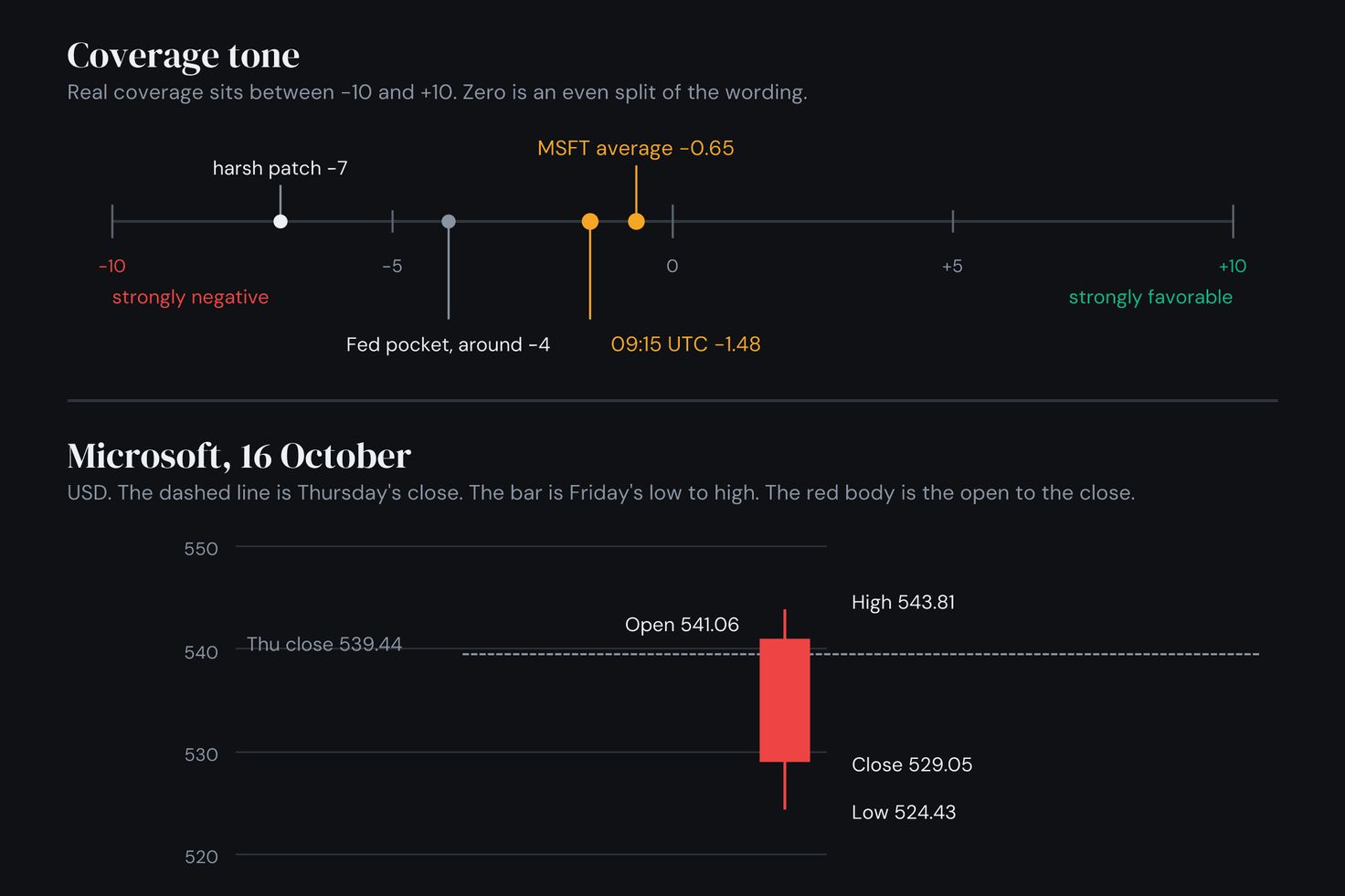
The Fed is the other half of that Friday. Warsh left the rate path unsaid. Coverage of his name sat around zero and a slight minus, with a harsher pocket around -4. The macro day was not a harsh day either.
Hold the four and each one does its own work. The stories name what was written. The sentiment says how hard the wider coverage took it. The Fed says whether the rate path, that day, was spoken as a hard thing or left open. The price says where the shares finished. None of them stands in for the others. Where they disagree, a lower close does not borrow the tone of a heavy headline.
The other morning is the one where they agree, and that is when the combination changes what you pay attention to. An average near -7 on the company. The Fed’s coverage down in the same hard pocket, not a slight lean with a pocket around -4. A close like 529.05 after an open of 541.06. Then the price, the macro, and the wording are pulling the same way. The day is no longer a loud title sitting on a mild average. You see that before you decide what the move was. The figures still do not say what to do with the shares.