Why Your AI Assistant Needs a Data Connector
An AI assistant knows how prices and markets work, but not this month's numbers. A data connector lets it look them up while it answers, with the source and the date. Two questions we asked with Sugra MCP attached: why coffee costs about double what it did in 2021, and what happened to TLT since 2020.
Published
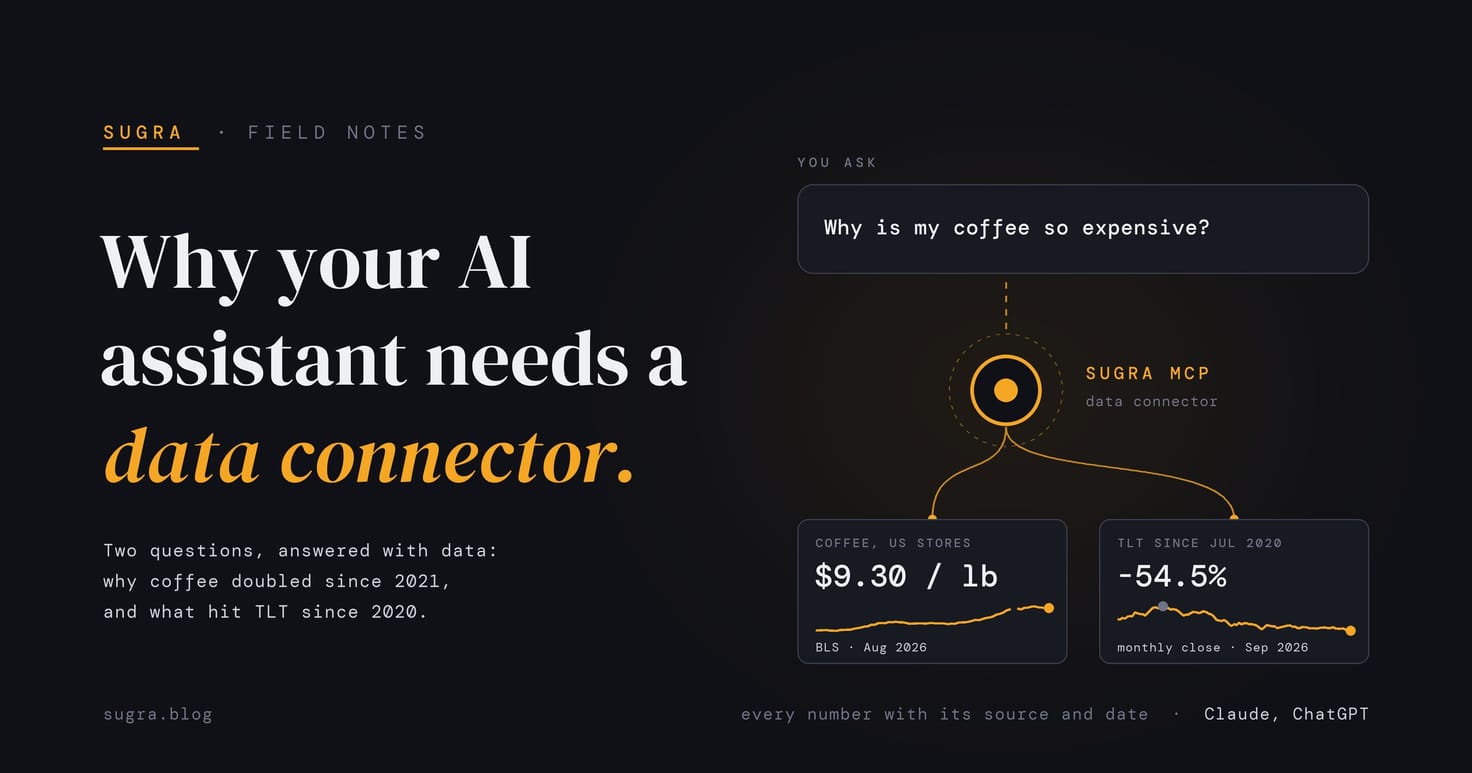
Ask an AI assistant why coffee got so expensive and it will explain how coffee prices work. Ask it what a pound of coffee costs this month and it can only guess, because this month’s numbers were not in anything it learned from.
A data connector closes that gap. The assistant looks the numbers up while it answers, and gives you each one with the source and the date. Sugra MCP is a data connector for Claude, Claude Code, ChatGPT, Codex, Grok, Cursor, Antigravity, GitHub Copilot, VS Code, Zed, Cline, Continue and any MCP client: 1,600+ endpoints across 36 domains, drawn from 160+ primary sources such as statistics offices, central banks and international agencies. In Claude and ChatGPT you add it once, sign in, and ask in plain words. There is no API key to copy.
The clip above is the first of two questions we asked with Sugra MCP attached. The second is what happened to a Treasury bond fund after 2020.
Why is my coffee so expensive?
The question, as a coffee drinker would type it: “Why is my coffee getting so expensive? Is it going to get cheaper next year?”
With Sugra MCP attached, the answer starts from the price itself:
- Ground coffee in US stores cost $9.30 a pound in August 2026, against $4.59 in January 2021: about double. That is the average price published by the US Bureau of Labor Statistics.
- Behind it are the beans. Arabica cost $3.59 a pound on the world market in July 2026, against an average of $1.33 in 2018, in the IMF’s monthly commodity prices.
- Cocoa went further: $10,710 a tonne in January 2025, against about $2,300 in 2018. It fell to $3,241 by March 2026, then climbed back to $5,619 in July.
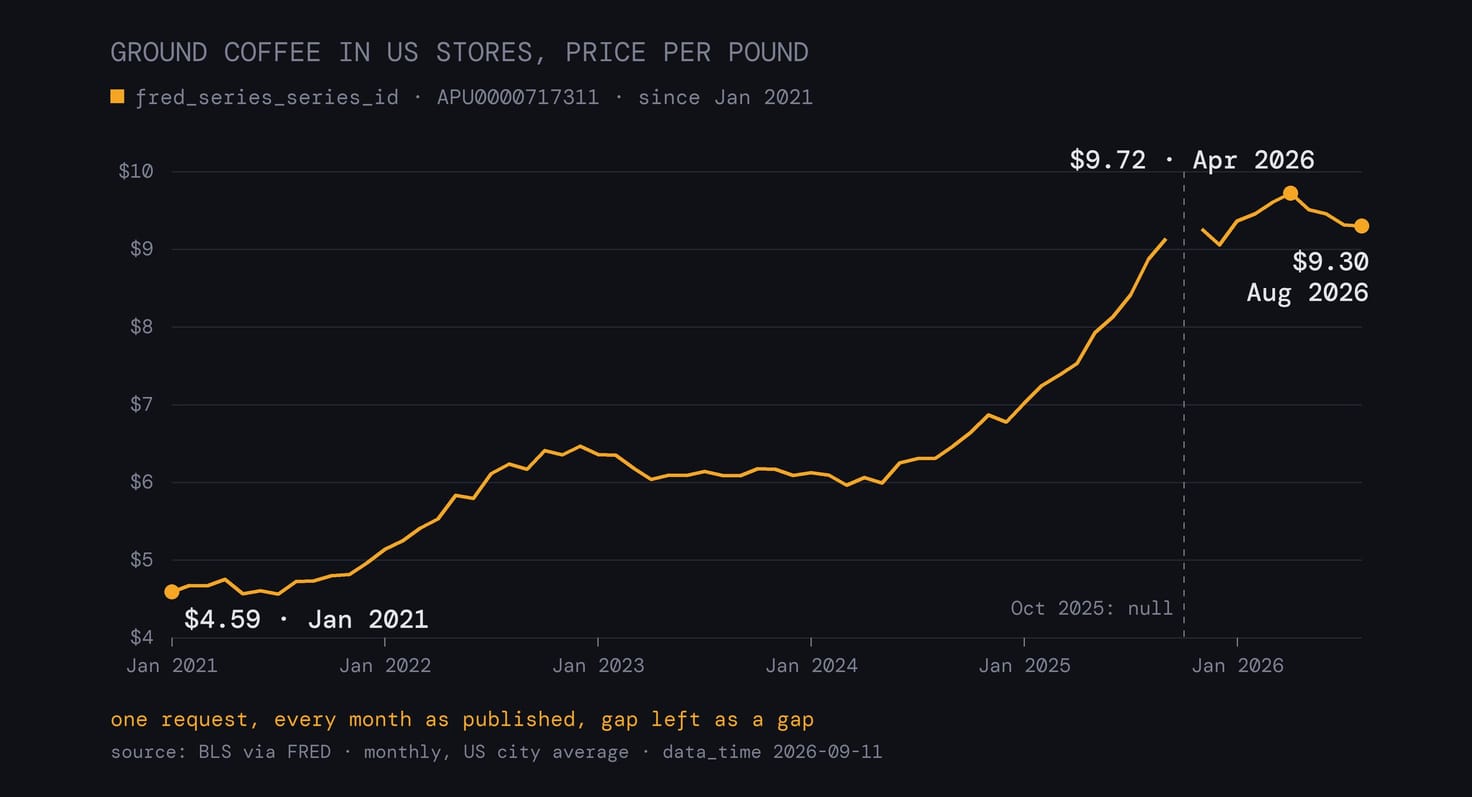
Data: one lookup through Sugra MCP, nothing else.
For the second half of the question, the numbers point both ways. The store price peaked at $9.72 in April 2026 and has been a little lower every month since. Arabica is below its November 2025 high of $4.10, but it rose from $3.08 in June to $3.59 in July. Whether coffee gets cheaper next year depends on harvests that have not happened yet, and an honest answer says so.
What happened to TLT after 2020?
TLT is a fund that holds long-term US Treasury bonds. We asked Claude, with Sugra MCP attached, what happened to it after 2020. It pulled the fund’s price history back to 2002, the Treasury yields behind it and the fund’s own list of bonds, and came back with three findings.
It lost more than half its price. TLT closed July 2020 at $171.00 and September 2026 at $77.78, down 54.5%. Counting the interest it paid out along the way, the loss since 2020 is 44.8%.
Most of the damage came from real interest rates, not inflation fears. When long-term rates rise, bonds already issued lose value, and long bonds lose the most. The 30-year Treasury yield went from 1.31% in July 2020 to 5.37% in September 2026, in monthly averages. More than three of those four points came from the real yield, what the bond pays after inflation, which went from -0.29% to 3.09%. Expected inflation, the gap between the two lines below, grew by less than one point.
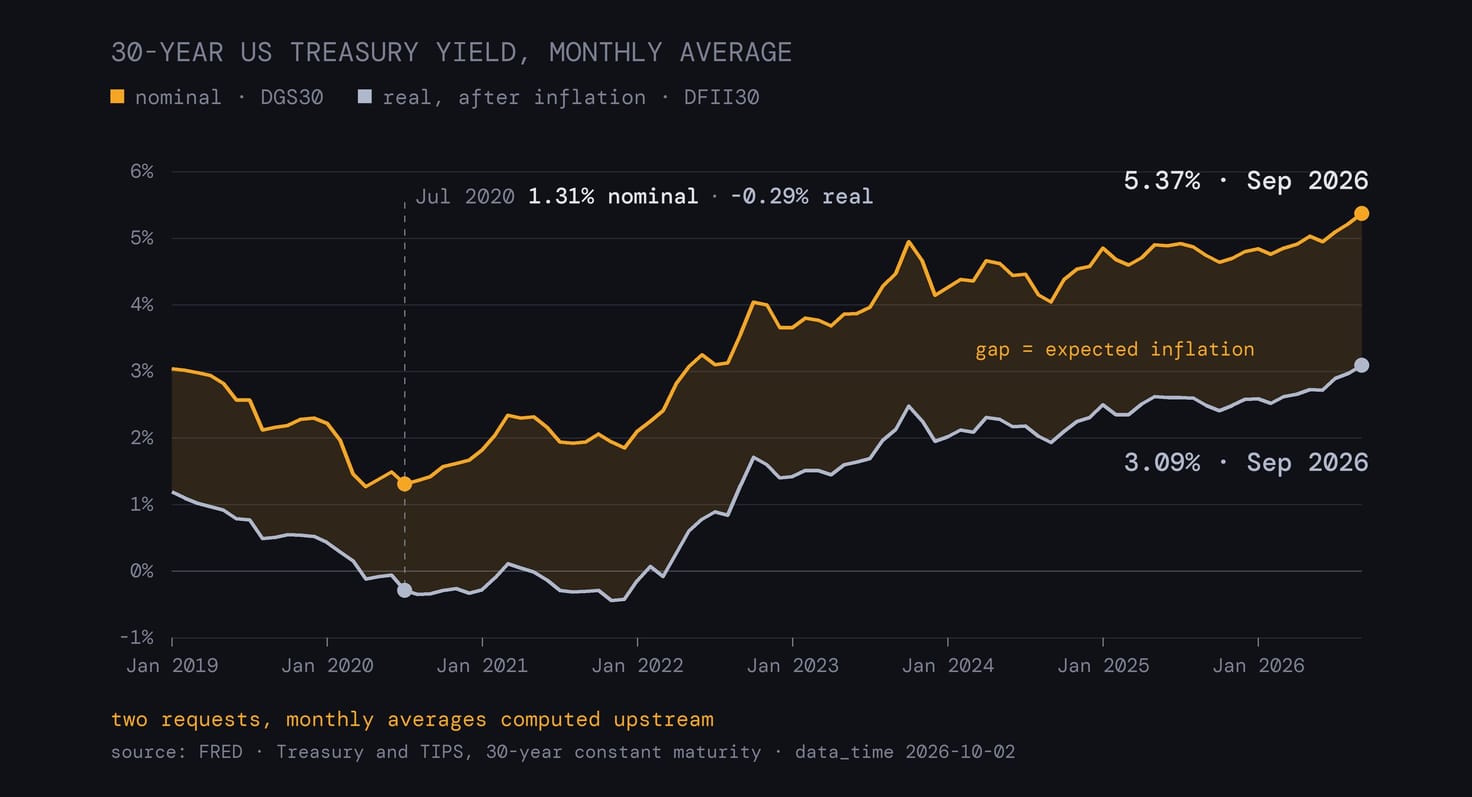
Data: two lookups through Sugra MCP, nothing else.
The hedge stopped working. From 2002 to 2020, in the 20 months when SPY, a fund that tracks the S&P 500, fell more than 5%, TLT rose 3.9% on average. Since 2021 there have been six such months, and TLT fell in all six.
This explains what happened; it is not advice on what to buy.
Add it once
In Claude, open the listing and press Connect to Claude. In ChatGPT, go straight to the listing. Either way you sign in to Sugra once, and there is no key to copy. For the other programs, the connect guide has the steps for each.
The Free plan gives 50 requests a day, and every plan reaches every endpoint. A question like the coffee one fits easily. The TLT one does not: looking inside the fund meant three lookups for each of its 46 bonds, 138 requests for that step alone.
For that there is now Personal: $9 a month for 1,000 requests a day, made for people who use Sugra MCP through their assistant rather than from code. You sign in the same way, and there is still no key to manage.
Links
- Add to Claude: url.sugra.ai/claude
- Add to ChatGPT: url.sugra.ai/openai
- Connect guide for the other programs: mcp.sugra.ai
- Get Personal: app.sugra.ai/subscribe/personal/monthly
- Create an account: app.sugra.ai/register
- Docs: docs.sugra.ai
Every price and yield in this post was computed from data Sugra MCP returned.