State of AI, February 2026: the pitch and the P&L
AI will replace everyone, agents will run unattended, AGI is around the corner - meanwhile 95% of enterprise pilots show no measurable return and spending is headed for $2.5 trillion anyway. A field survey of the divide: where the money goes, what quietly changed under the hood, what production agents actually look like, and what the robots at CES can and cannot do.
Published
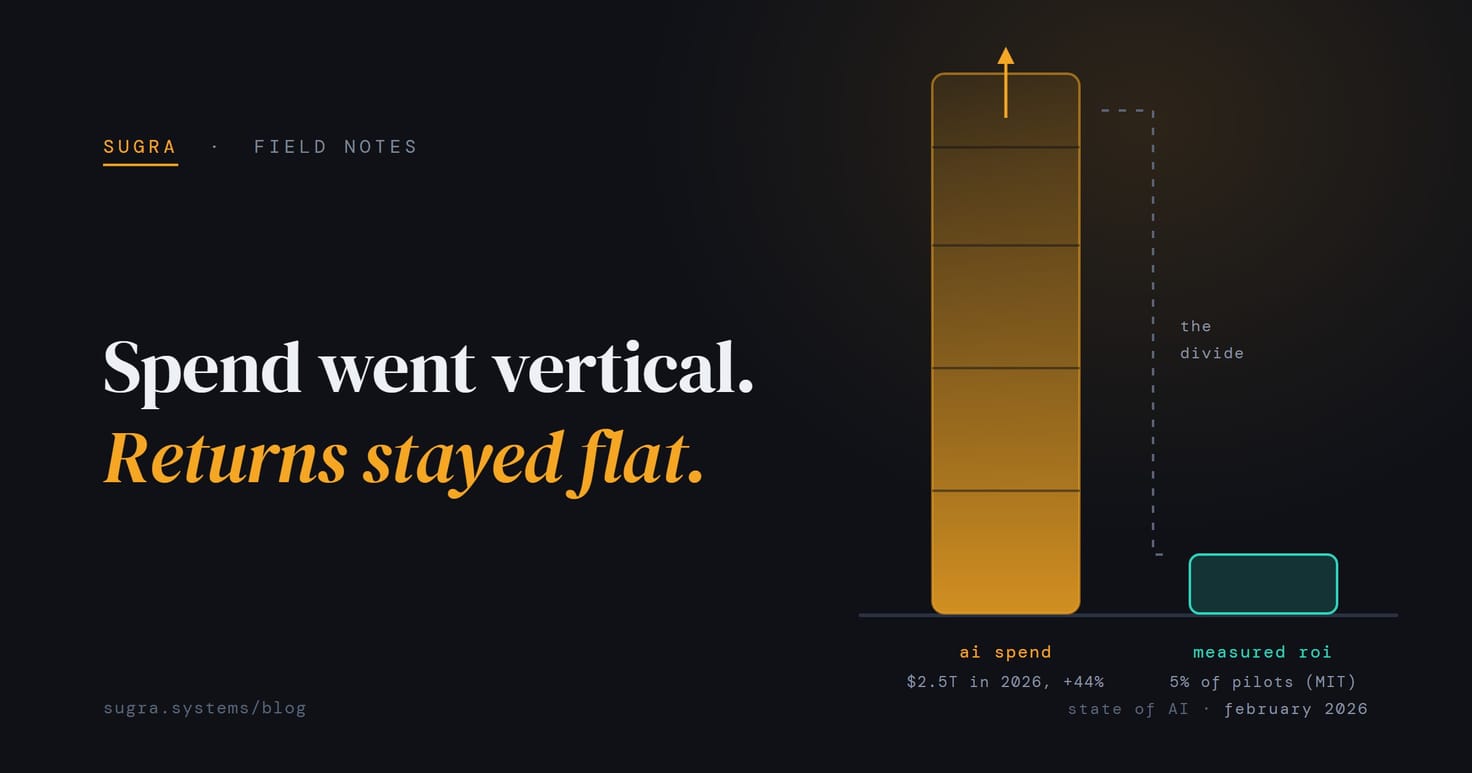
The narrative arriving with every keynote is consistent: AI is about to replace everyone, starting with developers; agents will run unattended; AGI is imminent or, depending on the speaker, already here. The numbers arriving with every audit are consistent too - they just describe a different industry.
The divide, in two numbers
MIT’s Project NANDA spent 2025 doing what keynotes do not: reading the deployments. Across 300 public enterprise implementations, 52 executive interviews and 153 surveyed leaders, the finding behind their report’s title - The GenAI Divide - is that about 95% of enterprise GenAI pilots produce no measurable P&L impact, on some $30 to 40 billion of investment. Only around 5% of custom tools ever reach production. The authors’ diagnosis is not model quality. It is a learning gap: tools that do not adapt to the workflow, and organizations that do not adapt to the tool.
The spending side did not wait for the returns. Gartner’s January forecast puts worldwide AI spending at $2.52 trillion in 2026 - up 44% in a year, most of it infrastructure.
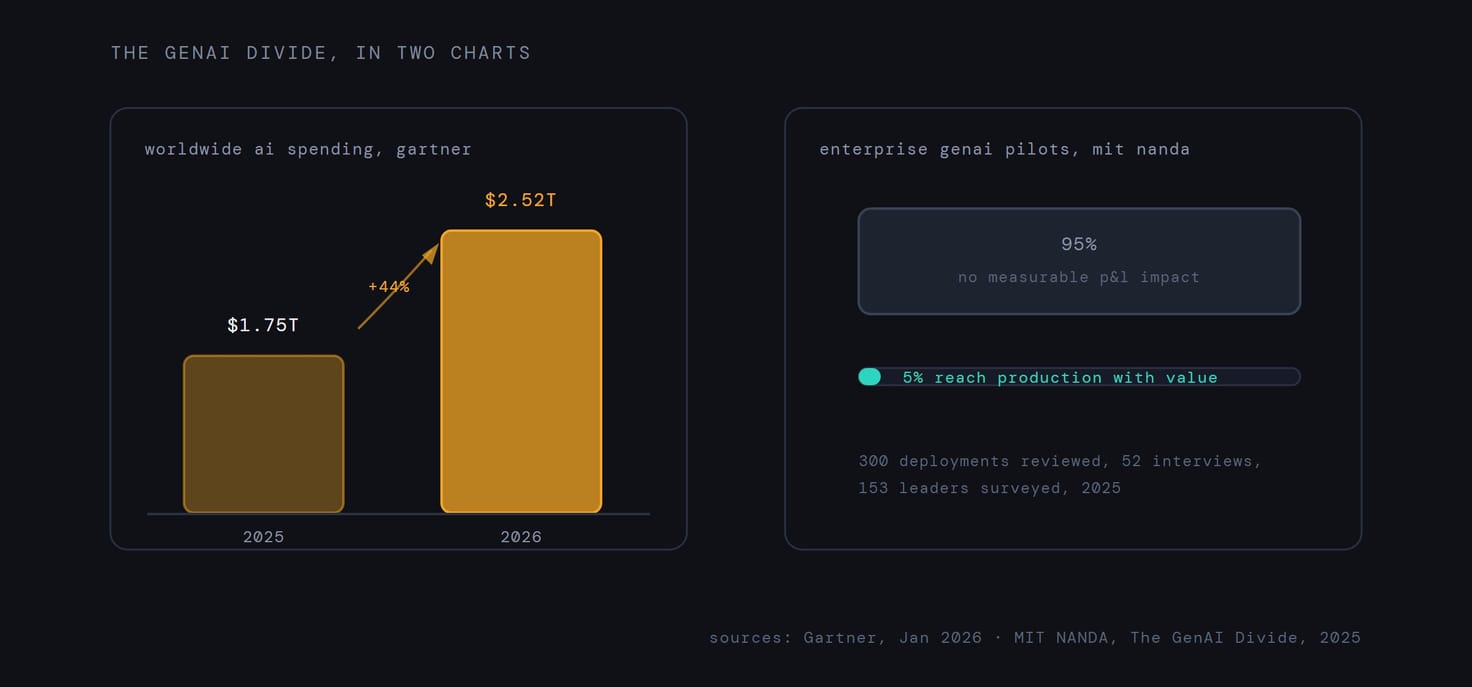
Sources: Gartner, January 2026; MIT NANDA, The GenAI Divide, 2025.
Deloitte’s 2026 enterprise survey - 3,200-plus leaders across 24 countries - explains how both numbers can be true at once: 84% of organizations have not redesigned jobs or the nature of work around AI. The model gets bolted onto the existing workflow, and the workflow is expected to transform itself. The same survey catches the dissonance in one pair: 36% expect at least a tenth of their jobs to be fully automated within a year, 82% within three - while five out of six have changed nothing about how the work is structured.
The marketing has its own contribution to the divide. Million-token context windows are sold as “paste your whole database into the prompt” - and every team that takes this literally discovers that indiscriminate context is not knowledge, it is latency: the SLA dies before the accuracy does.
The quiet pivot: efficiency over scale
While the front of the industry sold size, the back of it spent the year buying efficiency.
Training. Reinforcement learning with verifiable rewards, and GRPO in particular - the recipe DeepSeek-R1 made famous in January 2025 - showed that state-of-the-art reasoning does not require a separate critic model or the largest GPU fleet in the market. Rewards you can check mechanically turned out to be worth more than parameters.
Inference. Serving has two phases with opposite appetites: prefill wants raw compute, decoding wants memory bandwidth. The industry stopped pretending one chip should do both - NVIDIA’s Rubin CPX, announced in September, is a prefill-specialized processor (30 petaFLOPS of NVFP4, 128 GB of GDDR7) built for exactly this disaggregated serving, with the KV cache handed off between pools. Long-context economics is a hardware topology question now.
Models. NVIDIA’s research position paper on small language models made the argument out loud: for most invocations inside an agent - tool calls, structured extraction, routing - a model under 10B parameters is sufficient, and serving a 7B model is 10 to 30 times cheaper than a 70 to 175B one. The emerging production shape is heterogeneous: a strong generalist for the plan-and-decide moments, small specialists for the repetitive middle.
What production agents actually look like
The 2024 fantasy - autonomous agents writing and deploying code unsupervised - met hallucinations and infinite loops, and 2026 practice settled into a standard kit. Nobody serious runs agents in production without it.
Isolation and budgets by default. Sandboxes, read-only credentials, token and cost ceilings enforced before execution - the fences argument this blog made in December, now table stakes.
Memory as an engineered artifact. Long-term agent memory is moving to context graphs in the GraphRAG lineage, with explicit forgetting: eviction and decay policies that delete what stopped being relevant, because a memory that only grows is a context bill that only grows.
MCP as the tool interface. One protocol between agents and databases, APIs and tools - the layer that turned integrations from N x M adapters into N servers.
Durable execution. Agent state lives in orchestrators built on durable-execution patterns: a process can stop, wait for a human approval, and resume - which is what “human in the loop” means when it is engineering rather than a slide.
Semantic routing and structured outputs. Requests are classified and routed to the right model on the fly instead of stuffed into one giant prompt, and outputs are constrained at the sampler, guaranteeing schema-valid JSON. Parsing model text with regex is now a legacy pattern - one whole class of production failures deleted by construction.
None of this is exotic. It is the standards story again: what actually shipped is boring, file-based, and enforceable.
Physical AI: the same play, next stage
CES in January had one theme: Physical AI. Jensen Huang told the audience the “ChatGPT moment for physical AI” is coming; NVIDIA shipped Cosmos world models for synthetic training data and simulation; humanoids from a dozen vendors walked, waved, and were positioned as the answer to labor shortages.
The show floor and the keynote described different robots. The units on display work in tightly controlled environments on narrow, pre-programmed tasks - impressive mechanically, nowhere near open-world autonomy, with semantic task understanding still the unsolved core. The sober end of analyst estimates puts broadly deployable autonomous robotics five to ten years out. Retraining as a plumber remains a defensible hedge for a developer - mostly because the robots are not coming for the pipes any decade soon.
The take
Three things are simultaneously true in February 2026. The money is real: $2.5 trillion of it this year, growing 44%. The returns are mostly not: 95% of pilots cannot show a P&L line, and the cause is organizational - the learning gap - not the models. And the winners are recognizable: they redesign the workflow instead of decorating it, they buy efficiency rather than scale, and their agents run inside the boring standard kit, not ahead of it.
The state of AI in early 2026 is a $2.5 trillion bet that the 5% can be learned. The good news is that it can. It is just not in the keynote.
Reading
- The GenAI Divide: State of AI in Business 2025 - MIT Project NANDA, 2025
- Worldwide AI Spending Will Total $2.5 Trillion in 2026 - Gartner, January 2026
- The State of AI in the Enterprise 2026 - Deloitte
- Small Language Models are the Future of Agentic AI - Belcak et al., NVIDIA Research, 2025
- Jensen Huang: the ChatGPT moment for physical AI is coming - Axios, January 2026
- NVIDIA disaggregates long-context inference - The Next Platform, September 2025