How we run the company with Grok Bot
Coding agents write software. They do not run a company. The missing layer is an org chart of scoped bots on live data, with a human only when the action is consequential.
Published
Coding agents at the bottom. Role bots above them. Live data underneath. A human only when the action is consequential.
We did not need another assistant. We needed an org chart.
Coding agents could already write software. Writing code and closing tickets is not running a company. The missing layer sat between the editor and the CEO: mail, WhatsApp, Friday reports, a ComCom answer that must not leak into a blog draft, a measurement from RIPE Atlas, a route on a map, and the few decisions that actually need a person.
The change that matters is not a better model. It is moving AI from a tool in a tab into seats with scoped memory.
The industry now has a name for that shape. Grok Bot Galaxy put language on it that we already needed: a colleague with a desktop, not a browser tab; narrow bots with scoped memory; an outer loop that manages work and an inner loop that does it; finished work instead of babysitting. Useful vocabulary. Not a blueprint we copied. We already had the stack. Galaxy named what we were already installing.
This is not a story about a company on autopilot. It is the opposite. We start from the minimum that works, then expand. The architecture is already there. Usage grows on top of it.
Sugra is intelligence infrastructure - a live-data layer for agents - and we run the company on the same stack we sell.
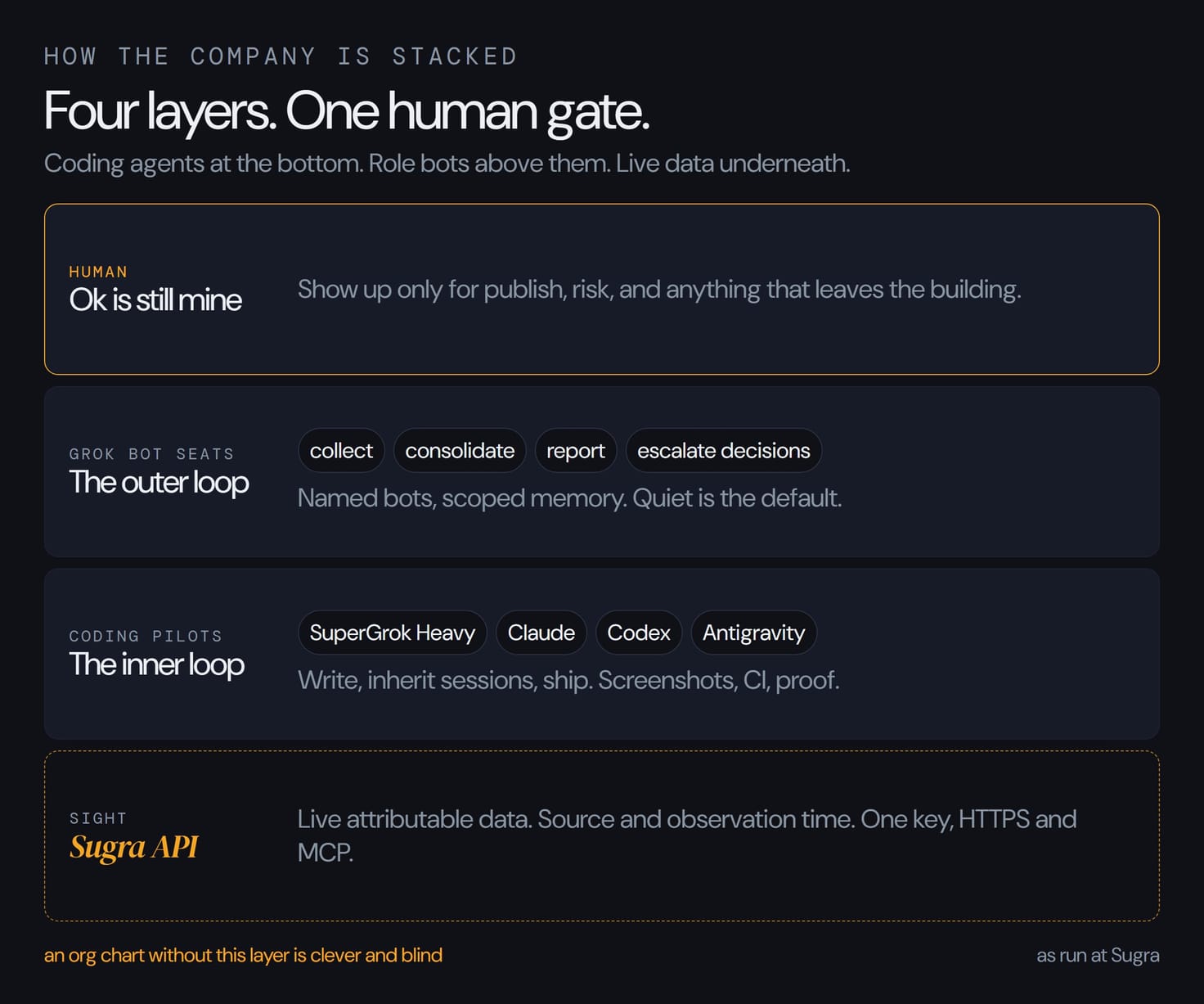
Four layers. The human is a gate, not a dashboard. Sugra API is sight underneath.
What was already shipping
In August we wrote about what SpaceXAI actually shipped in Grok Bot, and which credential questions to ask before anyone hands a bot a password (Welcome, Grok Bot). That piece was about the product and the risk surface.
Inside Sugra Dev Factory the picture was already live. The coding loop had seats that ship: SuperGrok Heavy, Claude, Codex, and Antigravity. Useful. Incomplete.
We were missing the middle: who gathers the day from mail and WhatsApp, who turns Friday team reports into one picture, who keeps domain work in its own thread, who escalates decisions instead of noise. And we were missing sight: where a bot gets a live number, instead of guessing from model memory.
The pilots
The inner loop is familiar if you live in an editor. Claude and Codex sit on the code. SuperGrok Heavy sits with them - and that seat is no longer “reviewer at the end of the diff.”
Heavy natively picks up Claude and Codex sessions. It writes. It takes notes. It runs parallel work while another model is still mid-flight. In our stack it is a main pilot, a note-taker, and a parallel worker. The mix changes with the task.
In that same mix sits Antigravity (Agy). For us it keeps winning the boring Google work - Google Cloud Platform, Tag Manager, Analytics. That may be subjective. It is repeatable enough that we staff for it. IAM, a GTM container, an Analytics property - Agy is often the first call. Not because a press release said so. Because the work lands.
Model versions matter because the seats are not interchangeable. We already put GPT-6 Astra and GPT-5.6 Sol through a public review (Two of six). A feedback loop is mandatory: screenshots, CI, proof. Without it the fleet cannot tell work from motion. With it I stay on what to do and what to kill, not on every keystroke.
The hands above them
Grok Bot sits above the pilots. Not as another coding agent. As an org chart of hands: collect, consolidate, connect, report, support decisions - and the daily work that used to live only in my inbox and my head.
Named bots keep scoped memory. A COO is not a debugger. Mail is not a publisher. ComCom is not GIS. Mix those jobs into one chat and you get noise instead of decisions. Each seat gets the minimum credentials and scope required for its job.
Product and publish
- Sugra-COO - weekday rollups at 09:00 and 18:00 Asia/Tbilisi; escalates decisions only.
- Sugra-Research - factcheck before CEO ok.
- Sugra-Dev - pings when a change is PR-ready.
- Sugra-Content - draft, then Research, then ok. No publish without ok.
Communications and the week
- Mail - Microsoft 365: sorts the morning; drafts when asked; does not send externally without ok.
- Weekly Reports - Friday and Saturday team reports: who is silent, one CEO summary instead of eight threads.
- WhatsApp - listens to the chats that matter, turns voice into notes, extracts tasks, and keeps follow-ups alive so they do not die in the scrollback.
Domain seats
- ComCom Analytics - Georgian Communications Commission work.
- RIPE Atlas - measurements, with RIPEstat and PeeringDB beside them when needed.
- GIS Expert - KML and QGIS, optical links, radio coverage, routes on the map.
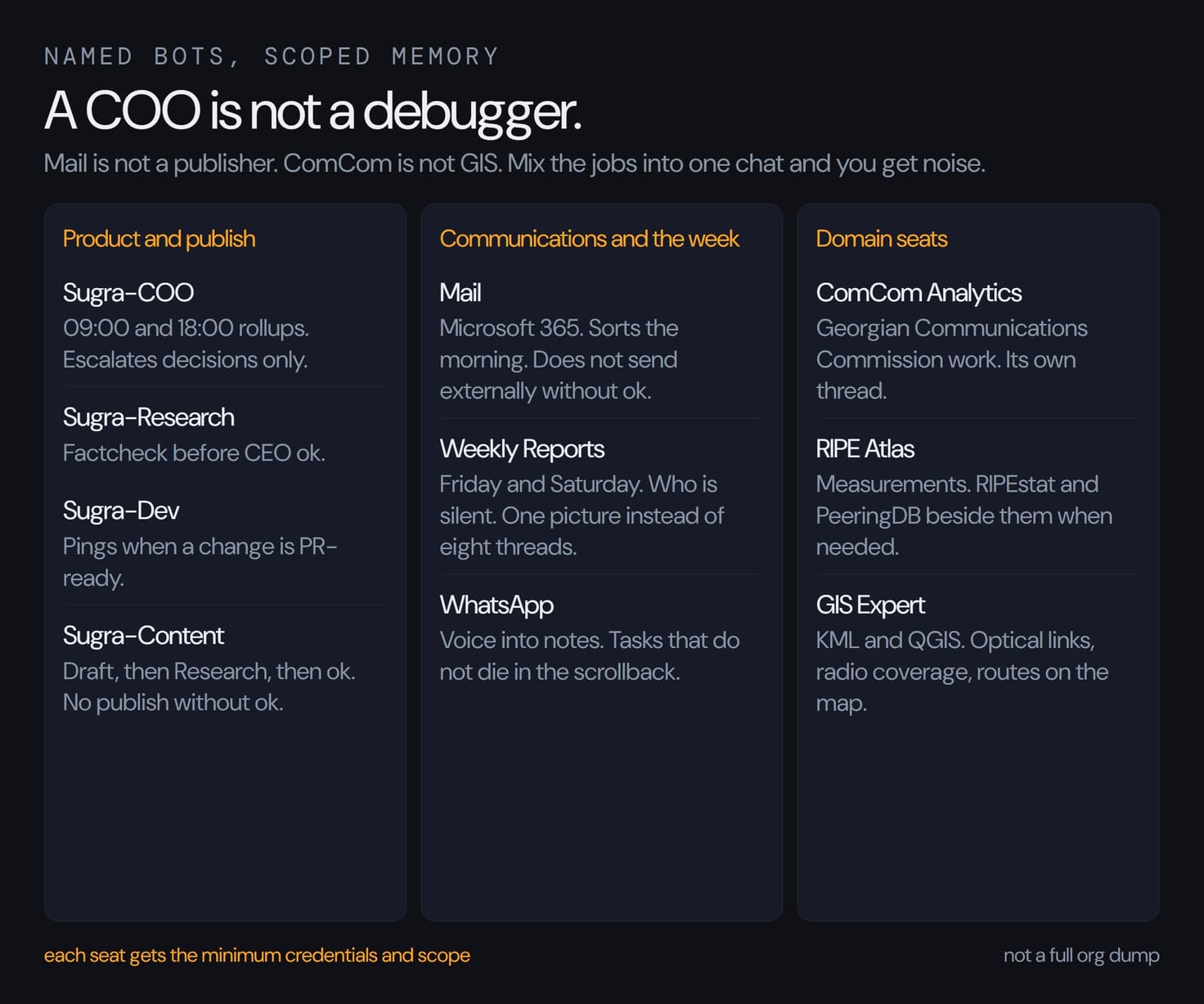
A COO is not a debugger. Mail is not a publisher. ComCom is not GIS.
There are more seats - calendar Chief of Staff, founder-comms, LinkedIn / X / GitHub surfaces. The point is not a full org dump. The point is that these jobs live as colleagues with scoped memory, not as one omniscient chat that pretends to know regulation, networks, and a blog draft in the same breath.
Quiet is the default. Not every newsletter is a ping. Not every voice note is a meeting. What rises is summaries, open tasks, and decisions.
One week, early but exact
A weekday looks less like a dashboard and more like a relay.
Mail has already sorted the overnight. COO’s 09:00 rollup is three decisions, not thirty threads. A ComCom question arrives in its own seat. Research factchecks. If a live figure is required, the bot calls Sugra API through Skills and cites source and observation time instead of inventing a path. Content may be drafting in parallel, but the regulator answer does not leak into the blog.
Dev pings when a change is PR-ready. Heavy may inherit a Claude or Codex session midstream. Agy may own the Google-cloud slice. WhatsApp becomes a note plus a tracked task, not another meeting. At 18:00 COO folds only what still needs a person. Friday and Saturday, Weekly Reports lands as one picture: who is silent, what moved, what is stuck.
I show up for publish, risk, and anything that leaves the building.
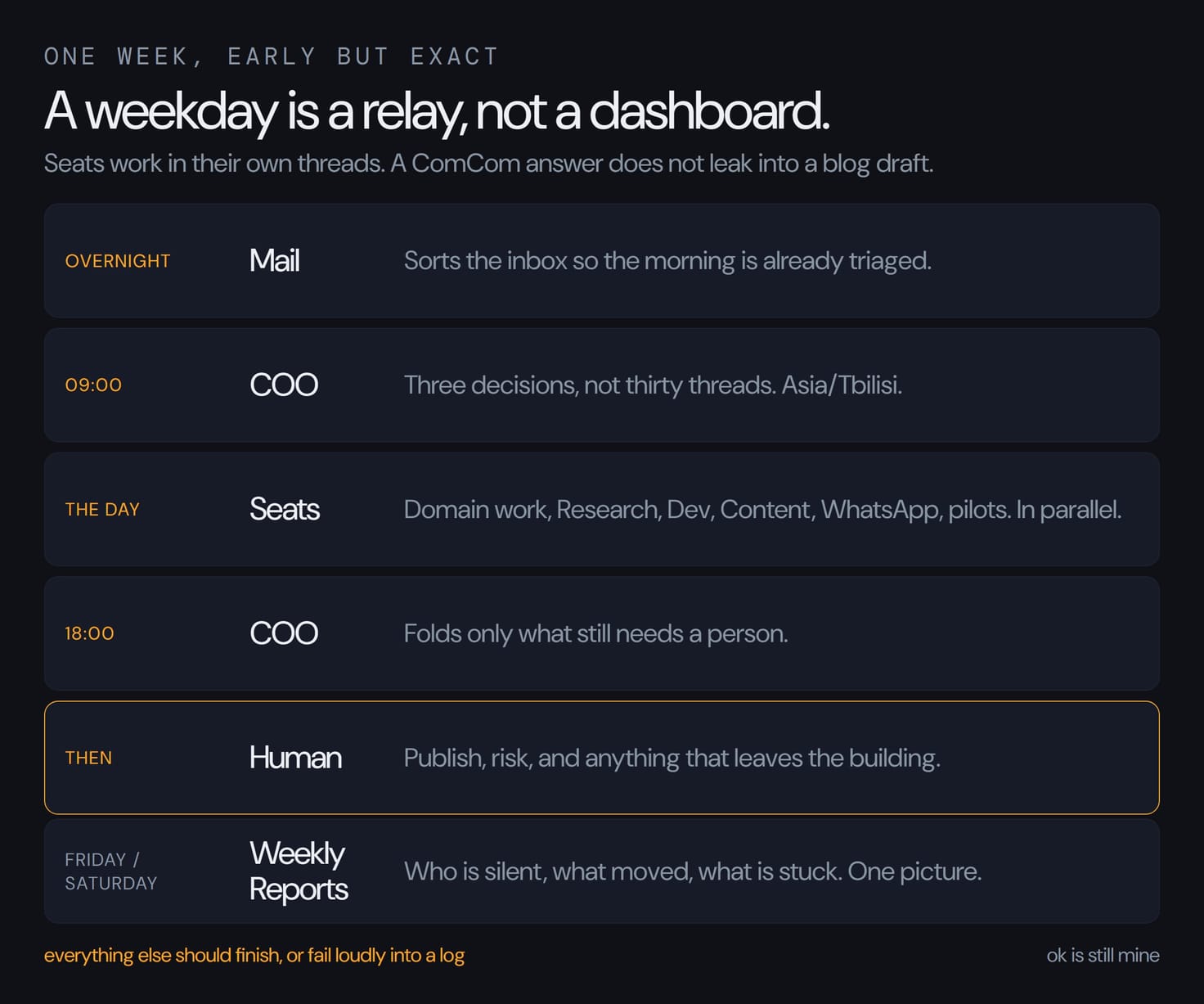
A weekday is a relay. Friday and Saturday collapse into one picture.
This is early. It is exact enough to run. We expand from the minimum. The architecture is already standing.
Sugra API: the actual-data layer
Hands still need sight. A model without live primary data refuses, answers from frozen training memory, or pulls “something” from search. We already wrote that down (AI Needs Live Data).
Sugra API is the observation layer under the seats - one key, HTTPS and MCP, live attributable data instead of frozen memory or a search guess. Grok Bot connects through The Sugra API Skills. Skills are procedure. The bot knows where to call and how to cite source and observation time.
An org chart without this layer is clever and blind. With the API, the hands get vision. That is the other half of this stack, and the reason to open those two posts after this one.
Quiet until consequential
Agents bias toward action. The rule is the opposite: stay quiet until a human is required. Ok is for publish, risk, and anything that leaves the building. Everything else should finish, or fail loudly into a log. Ok is still mine.
Pilots write and specialize. The Bot fleet runs the week and escalates only decisions. Sugra API supplies live, attributable data. The outer loop does not replace the pilots. It wires them, and it owns the non-coding work that used to interrupt coding.
People at the core
Bots as seats, people at the core. Pilots fly. Role bots hold the middle. Sugra API is sight. Playbooks on disk hold the truth. The consequential gate stays with me.
We are not building a company without people. We are building a company where software holds more of the organizational load, and people remain where judgment matters.
We are not selling a demo of a company that runs itself. We are installing an org chart that can grow into the work - quietly, until the action is consequential.