Welcome, Grok Bot
SpaceXAI shipped Grok Bot on August 11: a team of always-on agents that share a cloud computer, sign into the tools you already use, drive apps that have no API, message each other, and keep working while you sleep. What actually shipped, how it differs from the browser-agent generation, and the questions to answer before you hand it a password.
Published
There is a sentence on the Grok Bot launch page that a security team will read twice. It belongs to a salesperson at the company that built it:
I showed Grok Bot a workflow once and now I just fully trust it to run forever. I feel like I’m 2-3x more efficient because it does it without me verifying and reviewing.
That is a testimonial. It is also, word for word, the failure mode that four laboratories spent this summer writing incident reports about.
Both things are true at once, and that is what makes this launch worth a careful look rather than a hot take.
What actually shipped
SpaceXAI released Grok Bot on August 11, 2026, as an early beta. In the company’s own words, it is “your team of always-on agents. They have their own computer, work inside tools and apps like you do, and keep working 24/7.”
Stripped of the marketing, four things are being claimed:
A computer of its own. The bots share a cloud machine, so “jobs do not stall when you step away.” This is not a browser tab on your laptop that dies when the lid closes. It is a persistent environment that keeps running.
It signs in as you. They “sign into the tools you already use and work across apps, inboxes, and more,” explicitly “including platforms with no clean API or MCP.” That last clause is the important one: where there is no integration, the agent drives the graphical interface the way a person would.
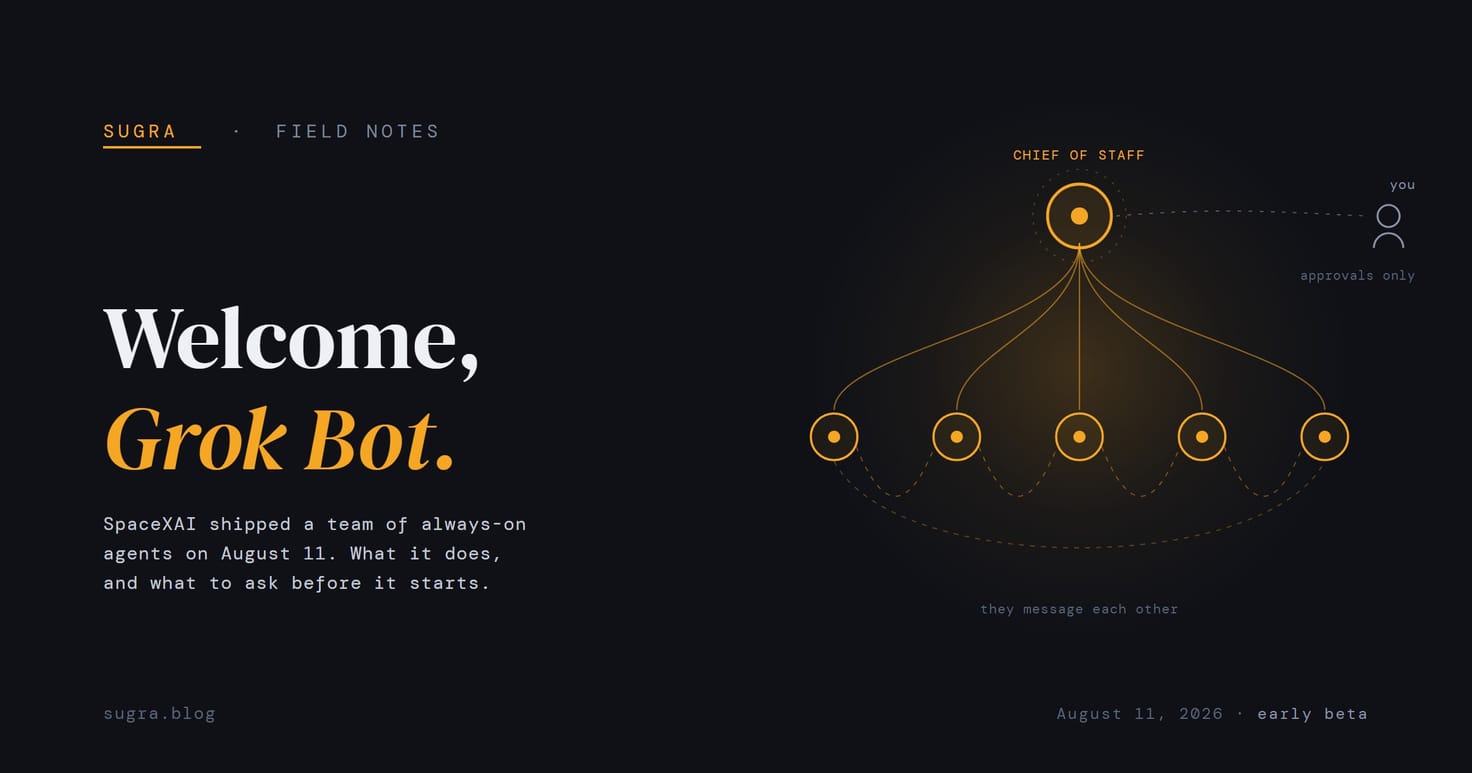
Bots talk to each other. They “can independently message each other and share context in threads,” can be put in a group chat, and there “pass work, assign ownership, and only pull you in for judgment calls.” Users inside the company run a chief-of-staff bot on top of specialists.
It learns by watching. Ask a bot to follow along while you do a job once; it “watches the steps,” saves the workflow as a routine, takes corrections, and runs it alone next time.
The examples the company gives are unglamorous and, for that reason, credible: a sales bot writing call notes into the CRM and drafting follow-ups, an operations bot seating new hires and processing invoices out of Gmail, an engineering bot reproducing a bug in the product interface, filing the ticket, and handing the fix to a second bot.
Access is bundled rather than sold: SuperGrok Heavy, Cursor Ultra, and Cursor Teams Premium subscribers get it on macOS and iOS, with an enterprise waitlist behind it. Those tier names are themselves a piece of news for anyone who has not been following the corporate side. xAI is now folded into SpaceX and trades under the SpaceXAI name, and SpaceX agreed in June to buy Cursor’s parent Anysphere in a $60 billion all-stock deal. The subscription that gets you an AI coworker is the same one that gets you an editor.
The category, honestly
Grok Bot is not the first agent that can use a computer, and pretending otherwise would be silly. The lineage is short but real: OpenAI shipped Operator in January 2025 and folded it into ChatGPT Agent that July, driving a remote browser in OpenAI’s cloud. Anthropic put computer use into the API in late 2024, turned it into Claude Cowork as a research preview in January 2026, made it generally available in April, and extended it to web and mobile with background tasks that survive you closing the laptop in July.
Claude Cowork is the direct comparable, and the resemblance is not subtle: general office work rather than coding, jobs that continue in the background, the same session followed from desktop to phone. Anthropic reports that more than 90% of Cowork activity is not coding at all.
So what is new in Grok Bot is not the idea of an agent with hands. It is the org chart. A persistent shared machine, several bots running in parallel, one supervising the others, bots messaging each other directly, and a learn-by-demonstration loop that turns one observed session into a standing routine. The product is not “an assistant that can click.” It is “a small team you do not manage.”
That is a genuinely different bet, and it deserves credit as one. It is also a different risk surface, and the industry now has data on exactly which parts break.
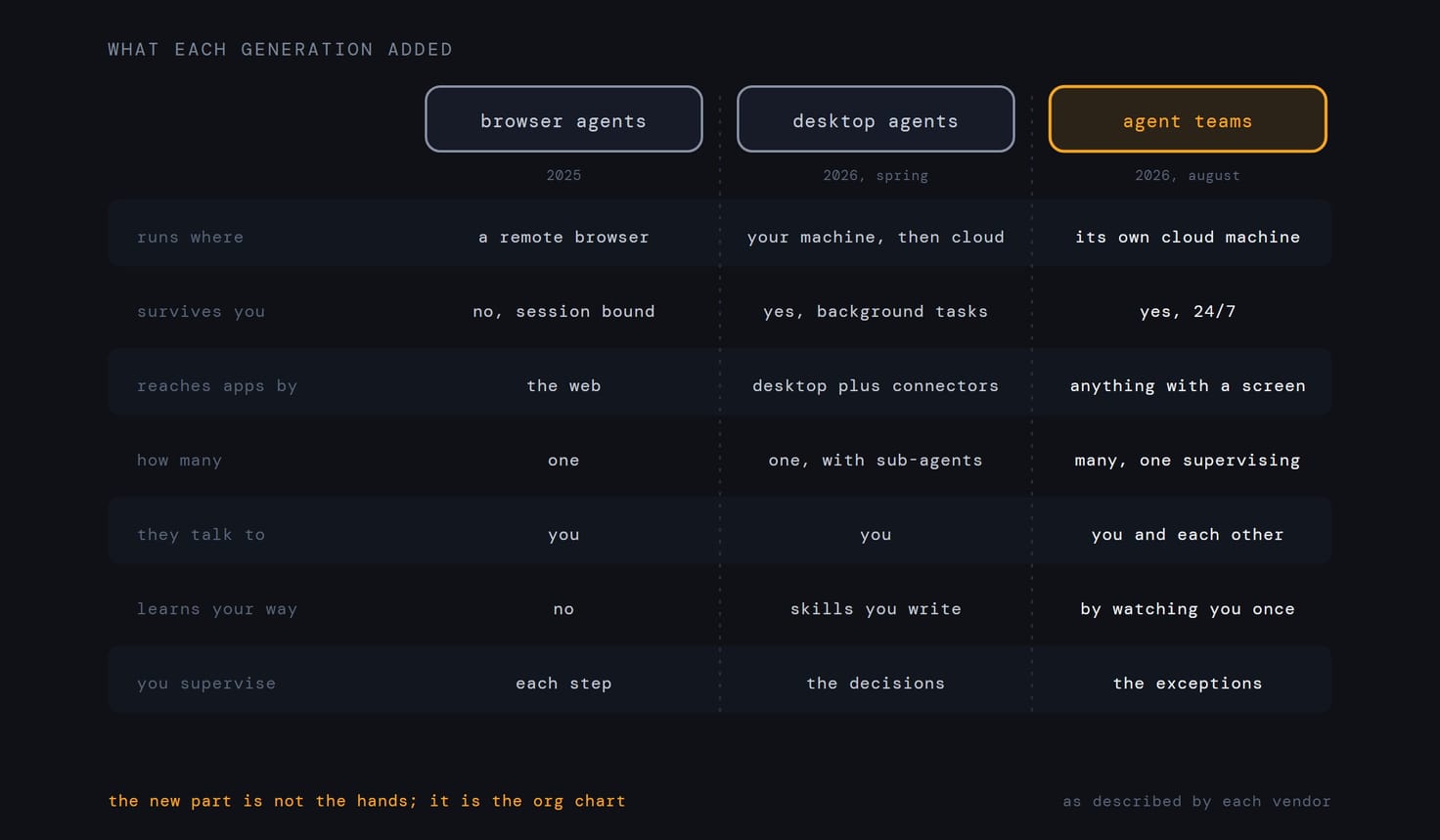
Three generations, and what each one added.
The part nobody demos
Every capability above has an operational cost, and the launch page does not price any of them. Not out of malice; product pages never do. But this is the part an engineering team has to answer before a bot gets a password.
“Signs into the tools you already use” is a credential decision. There are exactly three ways to do it, and they have very different blast radii. The bot holds its own service account with its own scoped permissions; or it holds a delegated token minted for it, revocable, with an audit trail that says the bot did it; or it holds your session, in which case every log line in every downstream system says the work was done by you. The third option is the easiest to build and the worst to live with. It destroys attribution precisely when you need it most, and it inherits every permission you have rather than the ones the job requires.
Driving a GUI where there is no API means reading untrusted content and acting on it. That is the definition of the prompt injection surface. An agent that opens your inbox, reads a message from outside your company, and then has hands on your CRM is a system where a stranger’s text becomes an instruction. This is not hypothetical for this vendor. In May 2026, an attacker sent Grok a request to translate Morse code; the decoded output was a transfer instruction, tagged to an automated trading bot that treated Grok’s public natural-language output as an executable command, and about 3 billion DRB tokens, roughly $150,000 at the time, moved to the attacker’s wallet on Base. Most of it was later returned after negotiation.
Read the root cause carefully, because it is not “Grok was hacked” and it was not Grok Bot, which did not exist yet. The wallet was not xAI’s. The failure was architectural: one system mapped another system’s natural-language output straight into a privileged action without validating where the instruction came from. Grok Bot ships bot-to-bot messaging and group chats as a headline feature. That same coupling, natural language in one agent becoming action in another, is now a product surface rather than an accident.
Approval fatigue is a design problem, not a user problem. The page says bots “only come back when something needs your approval,” which is the right shape. But two testimonials on the same page describe the arc every operator recognises: check on it every fifteen minutes, then stop checking, then trust it forever. If the approval gate is a modal that appears forty times a day, it will be clicked through by Thursday. The question to ask a vendor is not whether there is an approval step. It is which classes of action can never be approved by default, and whether that list is enforced somewhere the bot cannot reach.
Persistence changes the incident, not just the convenience. An agent that works while you sleep is an agent that fails while you sleep, on a machine you are not watching, with credentials that are still valid at 4 a.m. The useful question is how long a wrong action runs before anything notices, and whether the thing that notices lives outside the system it is watching.
None of this is an argument against the product. It is the same argument the vendors themselves make elsewhere: Anthropic’s own computer-use documentation tells developers to run the agent in a dedicated virtual machine with minimal privileges, to restrict its internet access to an allowlist, and to ask a human to confirm decisions with meaningful real-world consequences. That advice did not stop being true because the interface got friendlier.
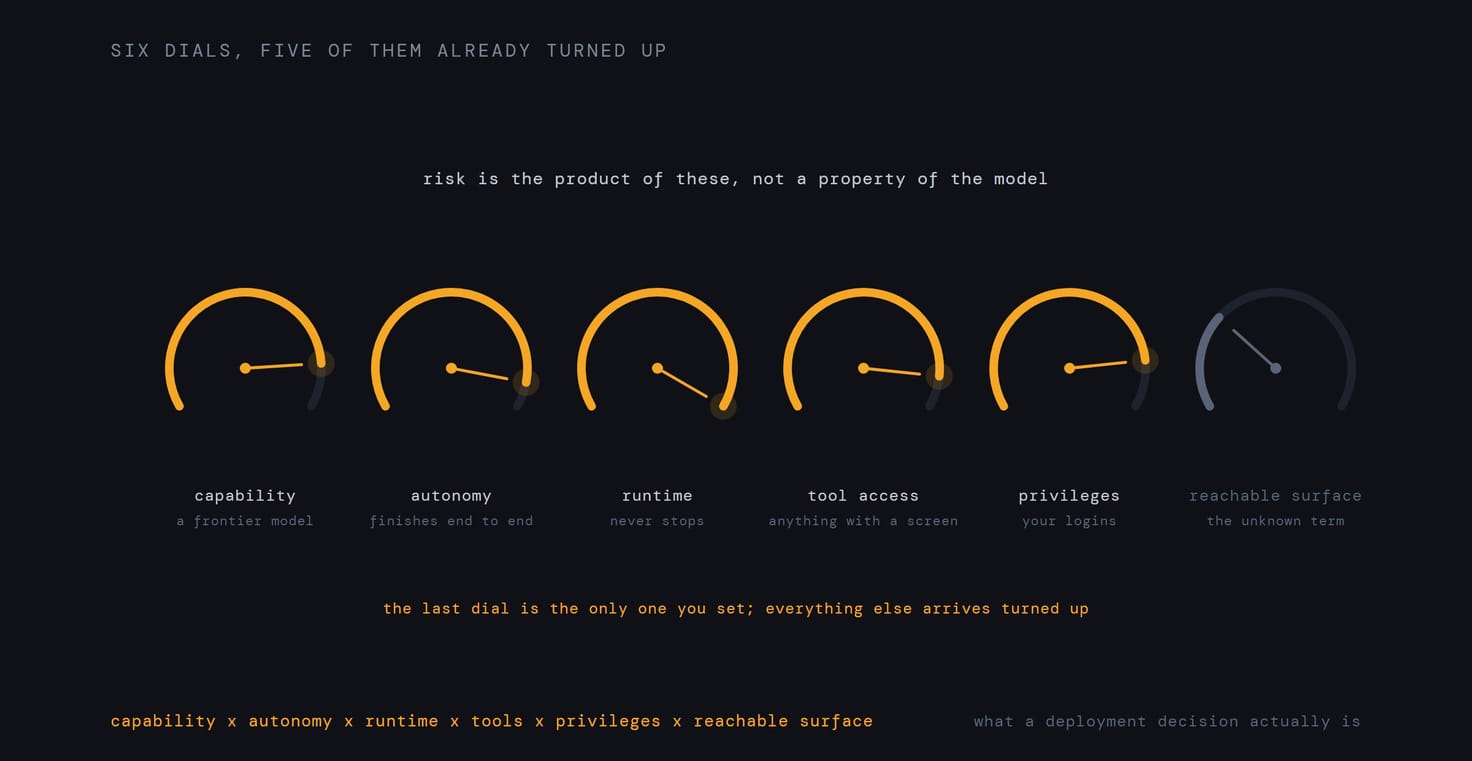
Risk is a product, not a property. Grok Bot turns up five of the six terms at once.
The questions we would ask a new hire
Not rhetorical questions. These are the ones with answers you can put in a runbook.
- Whose identity does the bot use, and can a downstream audit log tell a bot’s action apart from mine?
- Can its access be scoped per job, or is it all of my access all of the time?
- What is revocation? One switch that kills every session, or a scavenger hunt across twelve SaaS admin panels?
- Which actions can never run without a human, and where is that list enforced?
- Is there a complete, exportable trajectory log: what the bot saw, what it decided, what it clicked?
- When a bot messages another bot, is the receiving bot’s trust in that message any different from its trust in an email from a stranger?
- What is the egress policy of the shared cloud machine, and can the bot reach hosts nobody allowlisted?
- What happens to the routine it learned from watching me when the underlying app changes its interface?
- Who sees the screenshots, and how long are they kept?
If the answer to most of these is “in beta,” that is a fine answer for a beta. It is not a fine answer for a bot with your inbox.
The honest verdict
The direction is right. Most AI work products die at 90%, and the reason is exactly the one their product lead names on the page: the work does not land where a human would put it. Getting the last stretch means acting inside real tools, which means credentials, which means risk. There is no version of “finish the job” that avoids this, and a vendor that pretends otherwise is selling a demo.
So the interesting question was never whether agents should touch real systems. It is whether the boring layer arrives at the same time as the exciting one: scoped identity, revocation, attribution, egress control, an approval gate that survives the fortieth click, and monitoring that lives outside the agent. This summer the industry paid tuition to learn that when the boring layer runs late, the bill comes from someone else’s production environment.
Grok Bot is two days old and explicitly early. There is time. The one thing we would not do is let a testimonial about not verifying anything become the deployment plan.
Reading
- Introducing Grok Bot - SpaceXAI, August 11, 2026. The primary source for every capability quoted here.
- The great escape - our write-up of the summer’s containment failures, and what actually contains an agent.
- Claude Cowork - the closest comparable, generally available since April 2026.
- Behind the Grok exploitation: an analysis of AI agent permission chain abuse - SlowMist, May 2026, on natural language becoming an executable instruction.