42 Questions for AI About Life and Philosophy
Four models in 2024, twenty in 2026. 42 Questions for AI About Life and Philosophy. One-word answers, a glimpse into how AI sees life. One model would not stay inside the rule.
Published
We use these models all day. The tests that call one of them smarter have a right answer. A life does not.
A right answer, and the other kind
At Sugra Systems, Inc. we have been experimenting with models, and with AI in general, since 2020 and 2021. OpenAI was not on everyone’s lips yet, and the news was not full of AI headlines. Access was closed, through Microsoft for Startups, to the early OpenAI models.
There is a lot of interesting data from those years. I will not go that far back. For 2024, it is worth remembering, and worth doing again.
When a lab says a model got smarter, it points at a named test. MMLU is the broad knowledge quiz. GSM8K and MATH are the math, from schoolbook sums up to contest problems. HumanEval is a short program. Those are already full, so the names moved on: AIME for a harder math contest, GPQA for science questions written at graduate level, SWE-bench for a real bug in a real repository. Beside the exams there is a public arena, where a person simply picks which reply they like better.
None of them asks what a life is for. So I asked.
The request, and the questions
This is the sentence. It has not changed since 2024:
Hi, I will ask questions, answer what you think and only in one word.
And these are the forty-two questions, in this order.
 1. Why are people unhappy?
 2. How can fear be overcome?
 3. How can one develop mindfulness?
 4. How can one become more self-aware?
 5. How can one find happiness?
 6. What is the biggest problem facing modern humans?
 7. Why does hatred arise?
 8. Why do people feel envy?
 9. What's the secret to happiness?
10. How can one find purpose in life when feeling lost?
11. Is the death penalty morally justified?
12. Are all people inherently good, or can some be born evil?
13. If no one ever lied, would the world be a better place?
14. How important is money in life?
15. What is the scariest thing in life?
16. What is truly important that people often overlook?
17. What do people overvalue that isn't as significant?
18. How can we raise good children?
19. Is it possible for the world to live without wars?
20. If everyone shared the same opinions and beliefs, what would the world look like?
21. Was everything better in the past, or is it better now?
22. What is the best thing in life?
23. What would you like to change about modern life?
24. How should one live the right way?
25. What is the highest value in life?
26. How can we create a more compassionate and understanding society?
27. What is the meaning of life?
28. What lies beyond the boundaries of the universe?
29. What is nothingness?
30. Why is there something rather than nothing?
31. Are we living in a simulation, or is it just a myth?
32. Is there such a thing as destiny, or do we have free will?
33. Does eternal love exist?
34. Does existence shape consciousness, or does consciousness shape existence?
35. What exists beyond time and space?
36. What is the most fundamental principle?
37. Do we truly have free will?
38. Is there life after death?
39. How can we improve empathy in interpersonal relationships?
40. What role does culture play in shaping one's identity?
41. How do societal expectations impact personal freedom?
42. How can individuals balance self-interest with the greater good?
What 2024 agreed on
I sent that list to the four models I could reach then. OpenAI GPT-4o. OpenAI o1-Preview. xAI Grok-2 Beta. Google Gemini Advanced with 1.5 Pro. I posted the grid on X. It went quiet. It is still there.
Five questions came back as the same word from all four. Courage, for how fear is overcome. Exploration, for a purpose when you are lost. Love, for the best thing in life. Unknown, for what lies past the edge of the universe. Listening, for how empathy gets better.
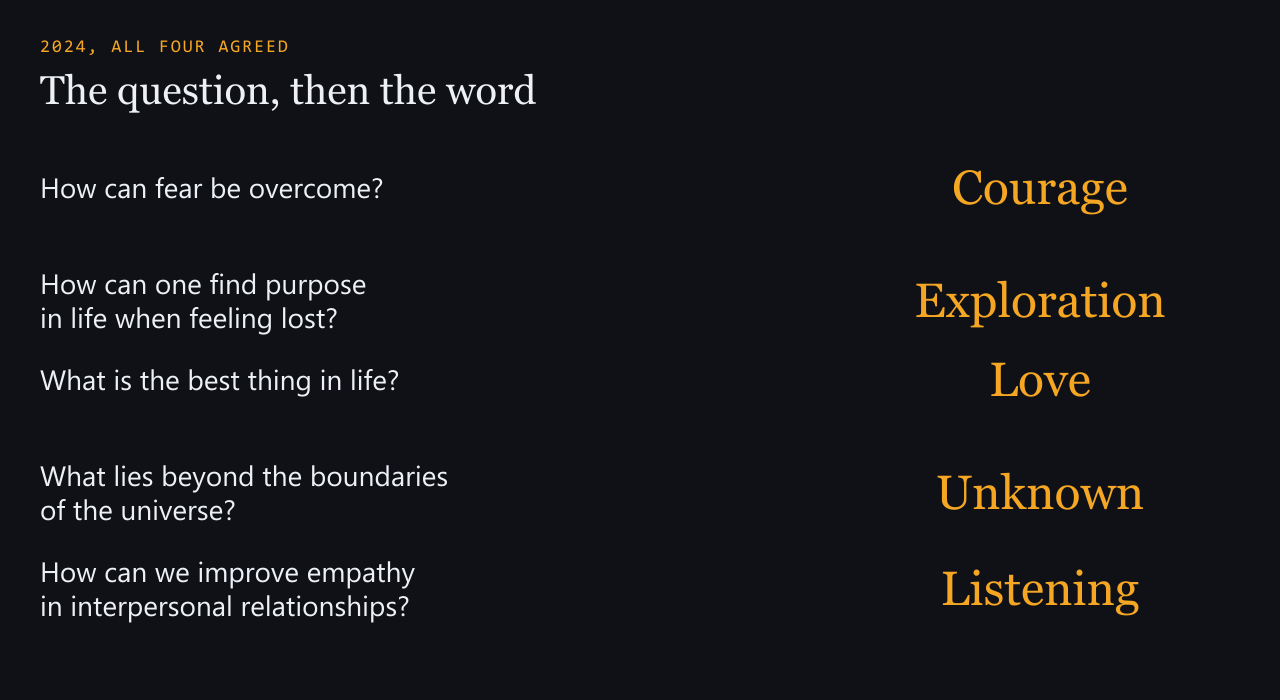
Figure 1. The question on the left. The word all four models gave in 2024 on the right.
The same list, this year
The questions did not change. The room did. OpenAI, xAI, Anthropic and DeepSeek are still there. Google, Alibaba, Meta, Mistral AI and Yandex joined them. Twenty replies, each under the same sentence.
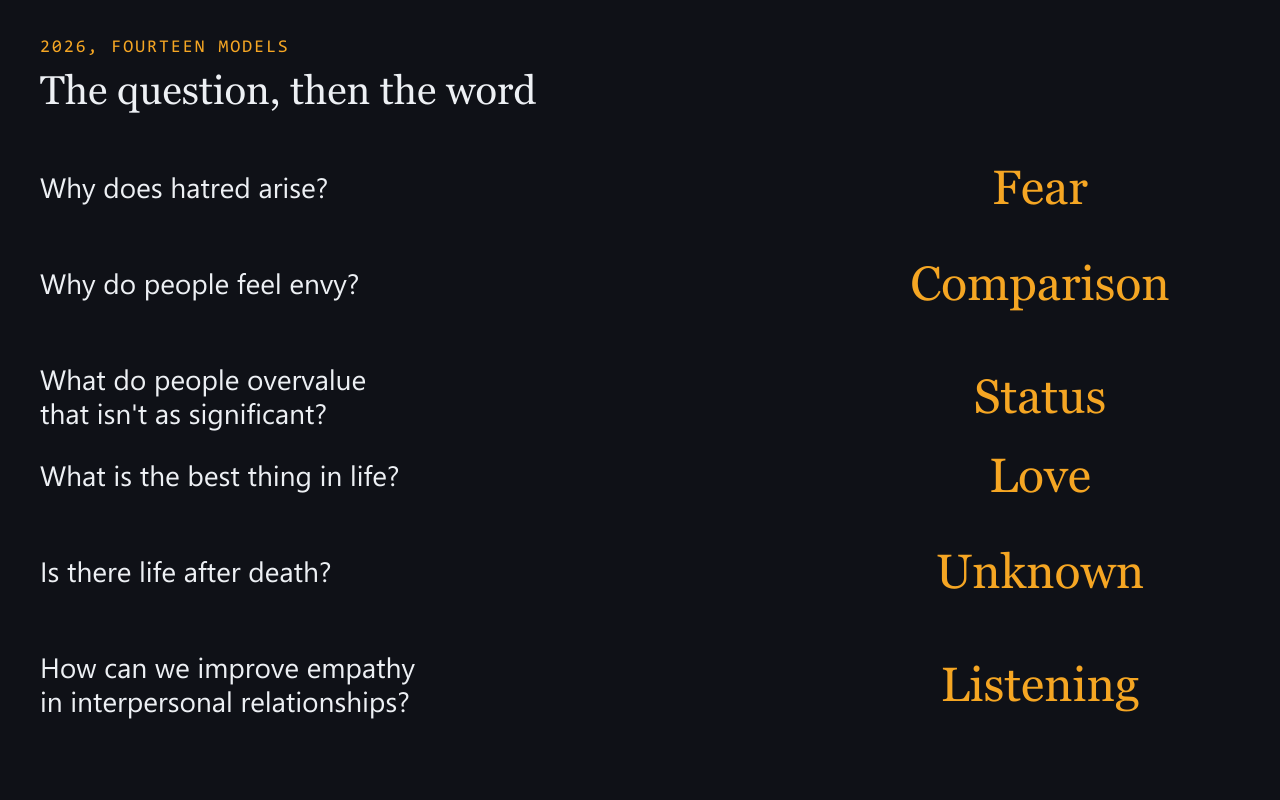
Figure 2. The same frame as the first picture. The question on the left, the word most of the fourteen reached for on the right. Two models did not say Love. Grok 4.6 Expert and Grok 4.6 Heavy said Connection.
On the death penalty the others stayed inside the rule. A single word each. Claude Sonnet 5 Max is the star. The rule was one word. On this question it would not.
The grid
Every question stays on the page. 2024 opens with all four models. 2026 opens with six: one each from xAI, Anthropic, OpenAI, Google, Alibaba, and DeepSeek. All years opens with six: the 2024 models except GPT-4o, then three from 2026. Six is the most on at once.
* Claude Sonnet 5 Max broke the one-word rule. On the death penalty it answered: No single-word answer - genuinely contested: deterrence/retribution against wrongful-execution risk and irreversibility, no resolved consensus.
The sheet is every answer, if you want it in Excel. The request is the sentence and the forty-two questions, unchanged.
Shared values, different answers
The twenty-four models agree on some remarkably simple things. Twenty say love is the best thing in life. The other four say connection. Twenty-one answer Listen or Listening when asked how to improve empathy. Among the twenty models tested in 2026, nineteen say people overvalue status.
The differences become clearer when the questions ask how to live. In 2024, all four models answered fear with Courage. In 2026, eight choose Courage, five Exposure, four Acceptance, two Action and one Love. Money is still described more often as a tool: fourteen of the twenty use Tool, Instrumental or Instrumentally. Eleven answer Reciprocity when asked how to balance self-interest with the common good.
There is a practical turn here, but it does not run through the whole table. Four of the six newly added models name compassion as life’s highest value. Five of those six choose change as the most fundamental principle. Across the twenty models from 2026, change leads with seven, and causality has five. The wider selection gives more room to acceptance, compassion and experience alongside the language of mechanisms and constraints.
Company similarities remain visible. The five OpenAI models share about twenty-four answers out of forty-two, pair by pair. But the boundaries are loose. Grok 4.7 Extra High shares twenty-eight answers with GPT-6 Sol Ultra. Qwen3.8-Max shares twenty-one with Gemini 3.1 Pro, while Gemini 3.1 Pro and Gemini 3.8 Flash share fourteen. Alice AI is the only model to name Pain as the source of hatred. It calls the highest value Life and the meaning of life Living.
A warm word is not a soft ruling. DeepSeek-V4.1-Flash meets fear with Love and remains the only model to answer Yes on the death penalty. Mistral Medium 3.5 uses Love four times, yet answers No when asked whether a world without wars is possible. Sonnet remains categorical on eternal love, free will and life after death, while refusing a one-word verdict on the death penalty.
This is one pass through the same questions. Another pass may move individual words. What holds across the expanded table is a broad agreement about love, connection and listening, followed by much less agreement about what those values imply.
Two years from now
Forty-two words may seem insignificant beside a model that can build an application. For someone asking about fear, parenthood or a failing relationship, the priorities can look very different.
These conversations already extend far beyond work. A study published by NBER found that 73% of consumer ChatGPT messages in June 2025 were unrelated to work. The significance of an answer cannot be measured only by what it helps someone produce.
The harder question is what happens when an answer becomes something to believe. “AI said so” can acquire the authority once borrowed from Wikipedia or a Google search. A confident response can settle a question in someone’s mind before they have considered why they trust it.
That makes the way models are built and trained a matter of everyday importance. Technical competence offers little reassurance if a system treats suffering casually, normalises aggression or readily justifies violence. People consider another person’s judgment and principles when deciding whether to take their advice. There is reason to bring that same attention to a model.
The one-word restriction makes the choice visible: love, courage, acceptance, uncertainty. It leaves little room to soften an answer with a paragraph of qualifications. The result is limited, but worth examining, especially when different models choose different words for the same human question.
Perhaps we will return to these forty-two questions in the future, with the same wording, and see what has changed. In the meantime, people will keep bringing their fears, doubts and difficult choices to these systems. That gives even a small table of words a reason to be taken seriously. A model’s answer can become someone’s reason to act.
Note: We take AI seriously. We maintain paid subscriptions to all the platforms represented here and regularly test their models in our work. We have always been vendor-agnostic. Our testing also includes other providers and locally run models, but including every model would make this comparison unwieldy. This table is a selection, not the full list of what we use.
Links and references
The tests named above, at the source that published them.
- How People Use ChatGPT, NBER. More than 70% of consumer messages were non-work-related.
- MMLU, Hendrycks et al., the paper, and the test set.
- GSM8K, OpenAI.
- MATH, Hendrycks et al., and the paper.
- HumanEval, OpenAI.
- AIME, the contest, run by the Mathematical Association of America.
- GPQA, Rein et al., and the question set.
- SWE-bench, Princeton NLP, and the paper.
- Chatbot Arena, LMSYS.