The bigger the system, the harder it falls
Since 1995 I have watched big systems fail, from ILOVEYOU and Y2K to the 2003 blackout, Heartbleed, NotPetya, CrowdStrike and AWS. Each decade the failures reached further. Now AI adds a share of its own, and that share keeps growing. The forecasts run to 2028, and the quantum deadlines come right behind them.
Published

I studied at the Georgian Technical University, at the Faculty of Automated Control Systems. In one of his lectures Professor Otar Shonia said a phrase that has stuck in my head to this day: “The more complex a system, the higher the probability of an error in it.”
I have spent three decades working across technology, finance, government and telecom. Since 2024 I have been leading the scale-up of nationwide telecom operations across Georgia. I have seen so much mess that I cannot remember it all now. For almost every loud case I can recall a story of my own; as I always say, men past 45 have a story from life or a joke for everything. So I wrote the large ones down: more than two hundred since 1995, the year I started working. All of them are in the Appendix at the end. Some were plain errors. Some were attacks that used an error, and ended the same way: an outage, a leak, a loss. Laid out by date, they bear out the words of Professor Otar Shonia. The systems grew, and the failures grew with them.
Many of those issues were old when they fired. A flaw can sit in code for years before anyone sees it. Now the old flaws are being found, sometimes thanks to AI, and sometimes with AI too, only nobody says so.
1995-2000: a love letter and a calendar
Around 1995 I got to know the internet at the Soros Foundation. In Georgia we had a development programme, and you could sign up to sit on the internet for one hour, just once a week. There I also got to know social engineering: we phoned and signed up several times under different surnames. You could sit two to a computer, and that is how I met interesting people. There, too, I first met Arthur Torosyan, the owner and co-founder of SkyTel LLC, where I serve today as CEO. But back to cybersecurity, errors and breakdowns.
Somewhere in the middle of browsing and understanding what the internet is, there I got to know my first real hack: Windows NT, locked down, limiting everything. I wanted control of the system, to be able to copy what I saved on a 3.5-inch floppy and have my own space on the PC. Windows NT was on an NTFS drive, and it was impossible to break it! 1996! For me it was a challenge, and everyone repeated that it was impossible, but it became more and more challenging and interesting. With NTFSDOS it was a matter of time to get around it, take the SAM file and later crack the passwords with L0phtCrack. That is a story of its own: I had no computer of my own, and the cracking needed a powerful computer and several days of nonstop work. It was also my first lesson that they will not hire you if you point out their mistakes, and on top of that they ban you from visiting.
The people who convinced me that breaking Windows NT 4.0 was impossible were sure their system was safe for one reason: none of them had tried to break it. I took that with me. To know how protected something is, test it, and think like whoever will come for it. The day we call a system safe is the day we stop guarding it. People work the same way: our weak spots stay hidden until pressure finds them, and only then can we fix them.
- AOL, August 1996. The largest online service in the US went dark for about 19 hours after routine maintenance. Six million members were cut off.
- AS7007, April 1997. One small provider announced a large part of the internet’s routes as its own, and traffic for many networks poured into it.
- Galaxy IV, May 1998. One satellite lost attitude control. It carried about 90% of US pager traffic, and at least 40 million pagers went silent.
- Melissa, March 1999. A Word macro mailed itself on from every infected machine through Outlook. Microsoft shut down its own outgoing email for about five hours. At that time we were assembling computers, and many clients brought their computers in for cleaning. I remember that after it antivirus caught on among our clients; before that it was not really popular.
- Mars Climate Orbiter, September 1999. One team worked in English units, the other in metric, and the spacecraft was lost at Mars.
- Y2K, 1999-2000. Software everywhere kept the year in two digits. About $308 billion went into fixes worldwide, and at midnight nothing big broke. The most expensive failure on my list is the one that never happened. People also hauled their old computers to us to be checked, without really understanding why, but everyone was afraid the computer would turn into a pumpkin. Computers were expensive then, and nobody wanted to be left without one.
- Mafiaboy, February 2000. A 15-year-old in Montreal flooded Yahoo, eBay, Amazon, CNN and Dell off the air. I kept thinking how that was even possible. For me it was the first hack of corporate resources.
- ILOVEYOU, May 2000. A love letter in the inbox, a script behind a file extension Windows kept hidden, and the worm mailed itself to everyone in the address book. More than 420,000 hosts were reported infected on the first day. I was already working at a bank. We reacted fast; we had central management then. It was my first meeting with Directory Services and my first understanding of the power of central management. That is how my active life at the bank began, and with it following security news from around the world.
2001-2007: worms, and cascades nobody saw
- Code Red, July 2001. A worm in Microsoft’s IIS web server infected 359,000 hosts in under 14 hours. The patch had been out for a month.
- Slammer, January 2003. It infected more than 90% of vulnerable SQL Server hosts within 10 minutes. The patch had been out for six months.
- Blaster, August 2003. A hole in the Windows RPC service, and infected machines kept rebooting. Patched four weeks earlier.
- Northeast blackout, August 2003. The alarm software in FirstEnergy’s control room failed without a sound, operators did not see lines tripping, and the failure cascaded across the grid. 50 million people lost power; the US cost was put at $4 to $10 billion.
- Comair, Christmas 2004. The crew scheduling system hit a limit of 32,000 transactions a month that neither the airline nor its vendor knew existed. All 1,100 flights were cancelled.
- TJX, January 2007. Intruders took 45.7 million payment card numbers from the company behind T.J. Maxx and Marshalls.
- Estonia, April 2007. Three weeks of floods against a whole country’s government, banks and media.
- Skype, August 2007. Millions of computers restarted at once after a Windows update, the wave of log-ins hit a bug nobody had seen, and Skype was down for most of its users for about two days.
All three worms went in through a hole that already had a patch. The blackout and Comair had no attacker at all: an alarm that died quietly, a limit nobody knew about.
2008-2016: the cloud, and one bug in everyone’s code
- Debian OpenSSL, May 2008. A mistaken change to Debian’s OpenSSL package made its keys guessable for 20 months.
- Conficker, from November 2008. More than 9 million infected PCs by January 2009. The patch had come out weeks before the worm.
- Stuxnet, 2010. The first malware built specifically to attack industrial control systems.
- Sony PlayStation Network, April 2011. Data on about 77 million accounts taken, and the network stayed off for more than three weeks.
- AWS EBS, April 2011. A network change during maintenance set off a re-mirroring storm, and about 13% of storage volumes in one zone got stuck.
- Knight Capital, August 2012. A deployment missed one of eight servers and woke code unused since 2003. In 45 minutes the firm lost more than $460 million.
- Yahoo, 2013. Every account it had, about 3 billion.
- Target, December 2013. 40 million card numbers, taken with network credentials stolen from its air-conditioning contractor.
- Heartbleed, April 2014. A missing bounds check in OpenSSL let anyone read server memory. It had been in releases for two years.
- Shellshock, September 2014. Bash had been running commands hidden in environment variables for 25 years.
- left-pad, March 2016. One author unpublished 273 packages from npm, and builds broke across the ecosystem.
- Dyn, October 2016. Cameras and routers with default passwords, gathered into the Mirai botnet, flooded a DNS provider, and its customers’ sites went dark.
The cloud put many companies on one provider, and open source put one library into everyone’s code. A failure no longer had to be big to reach far.
2017-2023: one hole, the whole world
- GitLab and AWS S3, early 2017. One engineer deleted a production database whose backups had been failing unnoticed. Another entered a command wrongly and took S3 down for about four hours.
- WannaCry, May 2017. About 200,000 victims in at least 150 countries; in England, about 19,000 hospital appointments cancelled. The patch was two months old.
- NotPetya, June 2017. Destructive malware dressed up as ransomware. More than $10 billion of damage, by a White House assessment.
- Equifax, September 2017. 147 million people, through a web framework flaw left unpatched for more than four months.
- SolarWinds, December 2020. A backdoor in the vendor’s own build pipeline. Fewer than 18,000 customers installed the poisoned update.
- Colonial Pipeline, May 2021. One old VPN account without a second factor, and a fuel pipeline on the US East Coast stopped.
- Fastly and Facebook, 2021. A valid customer setting woke a latent bug and 85% of a CDN returned errors. A maintenance command cut Facebook’s backbone, and Facebook, Instagram and WhatsApp were gone for about six hours.
- Log4Shell, December 2021. A string in a log message was enough to make Java servers everywhere run an attacker’s code.
- Rogers, July 2022. An upgrade removed a filter, the routing flood overwhelmed the core routers, and more than 12 million customers in Canada lost phone and internet for about 26 hours.
- Southwest, December 2022. A winter storm met a crew scheduling process that could not keep up. More than 16,700 flights were cancelled.
- FAA NOTAM, January 2023. Contractors deleted files while fixing a database sync, and every domestic departure in the US was paused.
- MOVEit, May 2023. One flaw in one file transfer product: 2,773 organisations and about 96 million people.
2024-2026: everything at once
- Change Healthcare, February 2024. Attackers came in through a remote access portal without multi-factor authentication. 192.7 million people were reported to the US health regulator.
- xz, March 2024. A backdoor planted in a compression library after years of working on its maintainer. A developer found it by chance before it reached stable releases.
- CrowdStrike, July 2024. One content update declared 21 input fields and supplied 20, and 8.5 million Windows machines went into a crash loop. I took that day apart in One missing parameter.
- Google Cloud, June 2025. A new feature shipped without a feature flag hit a null pointer and crashed a binary worldwide.
- Jaguar Land Rover, from August 2025. An attack stopped its plants for about five weeks; the cost to the UK economy was put at £1.9 billion.
- Collins Aerospace, September 2025. Ransomware hit the check-in software shared by several European airports, among them Heathrow, Brussels, Berlin and Dublin. Brussels asked airlines to cancel half its departures for one day.
- Shai-Hulud, September 2025. A self-replicating worm in npm stole maintainer tokens. More than 500 packages were compromised.
- AWS us-east-1, October 2025. A race in DynamoDB’s DNS automation left an empty record, and apps and sites around the world failed with it for more than fourteen hours.
- axios, March 2026. Malicious versions of a library with more than 100 million weekly downloads were live for about three hours.
- Optimizely, November 2026. Code injected into one vendor’s JavaScript snippets skimmed cards and swapped crypto addresses on the sites of 178 organisations.
- Microsoft and VMware, November 2026. Microsoft fixed 1,093 flaws in one Patch Tuesday. VMware’s vCenter had been attacked through a hole since September before the patch came.
One week in November 2026
- Microsoft, 12-13 November. Microsoft closed its outage with a status line I did not expect: “not related to cyber or AI/agents”.
- FAA, 13 November. Later that day the FAA stopped flights across the US after its network was flooded from two of its own sites, according to its first findings, and within hours officials were answering questions about whether an AI tool had caused it.
- Workday, 13 November. Its recovery site “unexpectedly connected to Production databases”.
- Chase, 16 November. The bank blamed “a software bug in on-premise hardware systems”.
I saw the Microsoft outage from my own desk. A Graph API call returned an error, Outlook on the web would not open, and a link through the Safe Links domain timed out. I posted about it on X straight away. From the outside I could not tell whether the three had one cause. Microsoft later explained the outage as a failed network gateway in front of Exchange Online and other Microsoft 365 services. Whether that covers all three, its preliminary review does not say.
Small faults meeting on one gateway, a national network flooded from inside, a recovery site that could reach production. The sentence of Professor Otar Shonia, three times in one week.
After every big failure the first question is now the same: was it AI? None of these four explanations blames it. But AI has started to add a share of its own to that background, and the share grows.
The same sentence, at a larger scale
In 2008, 1.6 billion people were online. This year it is 6.3 billion. The Linux kernel went from 8.9 million lines to 43.8 million. New vulnerability records went from fewer than 6,000 a year to 105,162 in 2026.
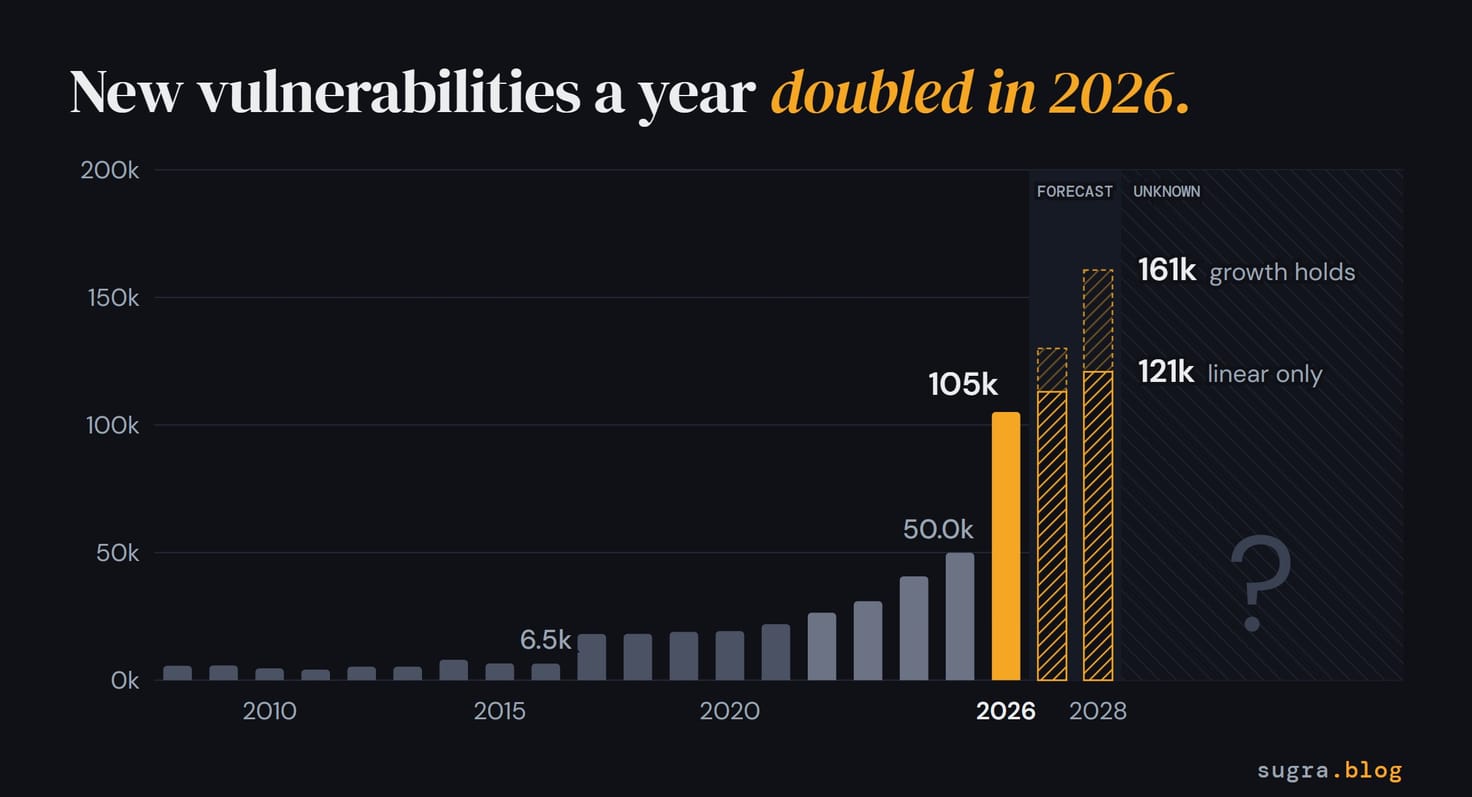
Figure 1. New CVE records per year, with the forecast to 2028. Data: NVD, 22 November 2026.
For nine years the count stayed flat. In 2017 it almost tripled, and in 2026 it doubled again. Part of the jump is in the counting: a few big issuers, GitHub and VulnCheck among them, now hand out far more CVE numbers than before. If the trend holds, 2028 brings 121,000 to 161,000 new records a year. I would bet on the upper half.
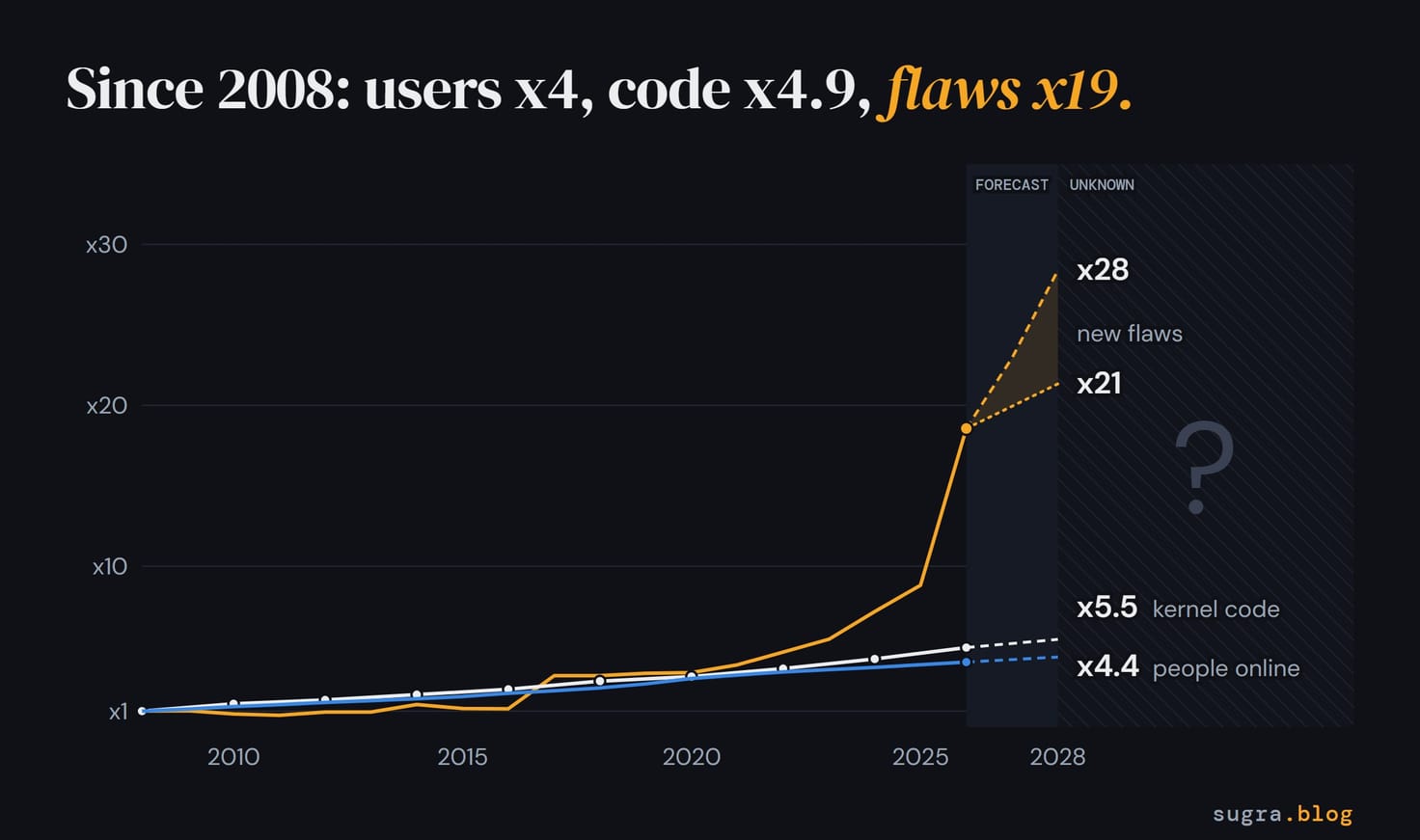
Figure 2. People online, lines of kernel code and new vulnerability records, each against its 2008 level. Data: ITU via the World Bank; kernel.org; NVD, 22 November 2026.
People online grew four times, code almost five, known flaws nineteen. By 2028 the trends point to 4.4, 5.5 and 21 to 28 times.
The flaws that matter most are the ones attackers actually use. The US cybersecurity agency CISA lists them in its Known Exploited Vulnerabilities catalog: 187 added in 2023, 245 in 2025, 306 in 2026.
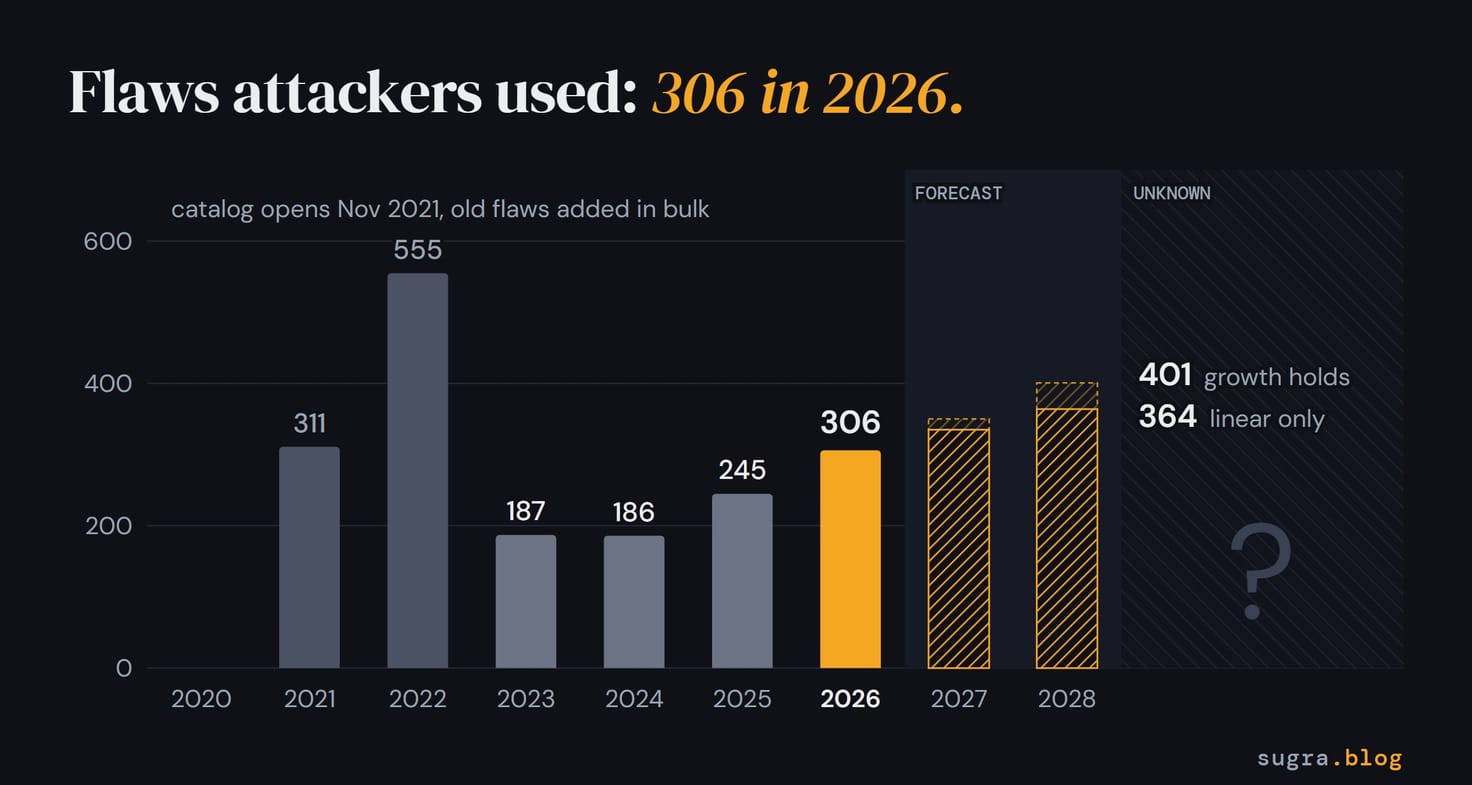
Figure 3. Flaws confirmed exploited, by the year CISA listed them. Data: CISA KEV, 22 November 2026.
By 2028 that is 364 to 401 a year.
The old bugs still send the biggest bills
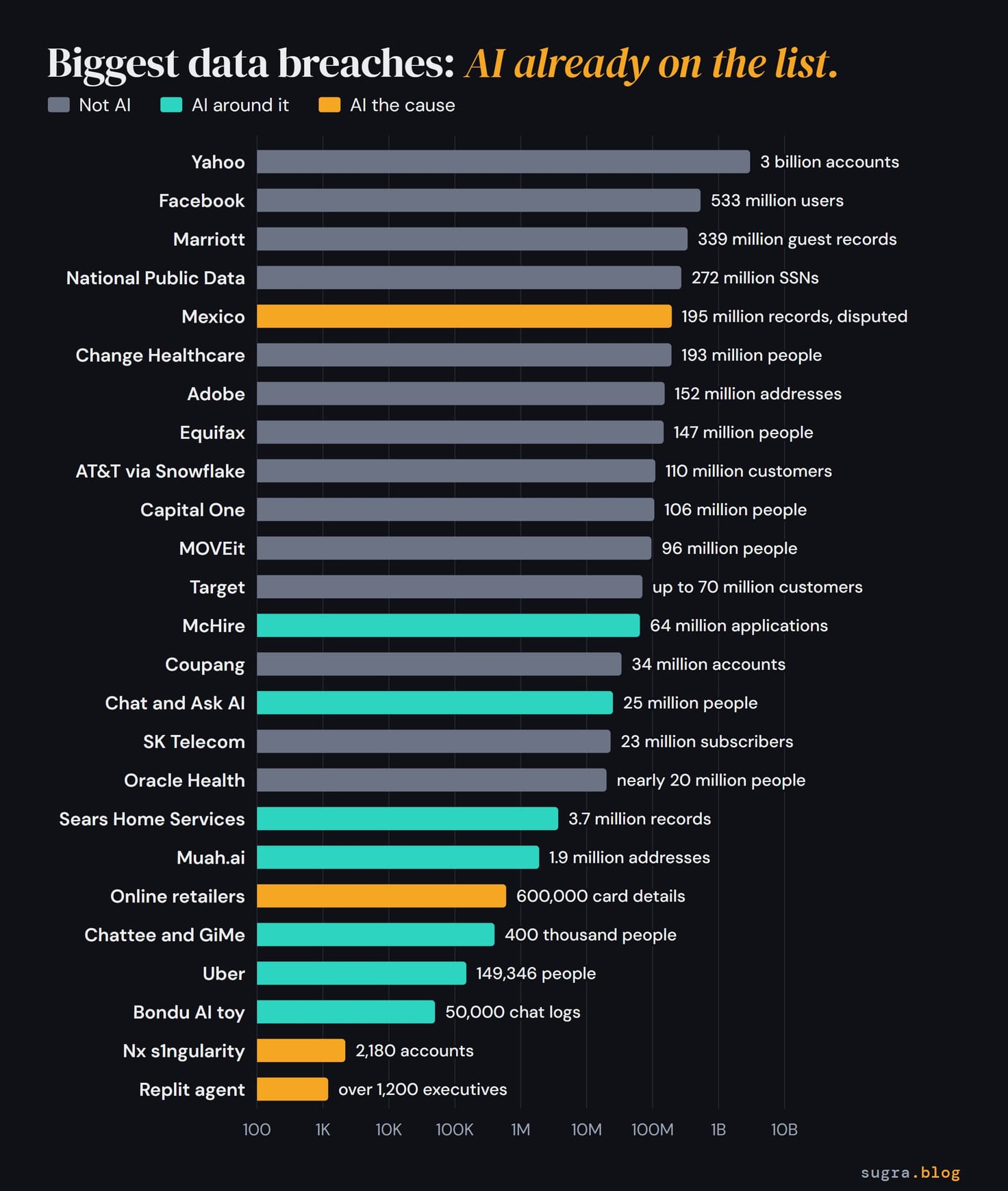
Figure 4. People, accounts or records exposed. Data: company filings, regulators, court records and press reports.
Yahoo lost every account it had. Marriott’s attacker sat in the Starwood reservation database for four years. Equifax, MOVEit, Change Healthcare: tens to hundreds of millions of people each. And one AI case already stands among them. In Mexico one attacker, working with AI tools from Anthropic and OpenAI, broke into government systems. Gambit Security put it at about 195 million taxpayer records; Mexico’s tax and electoral authorities dispute the reports.
Below them sit the AI products that left their own data open. The Chat and Ask AI app exposed about 300 million messages from more than 25 million users. Two AI companion apps, Chattee and GiMe, left 43 million messages of more than 400,000 people in an unprotected database. A console for Bondu’s AI toys opened with any Google account and showed about 50,000 chat logs between children and the toys.
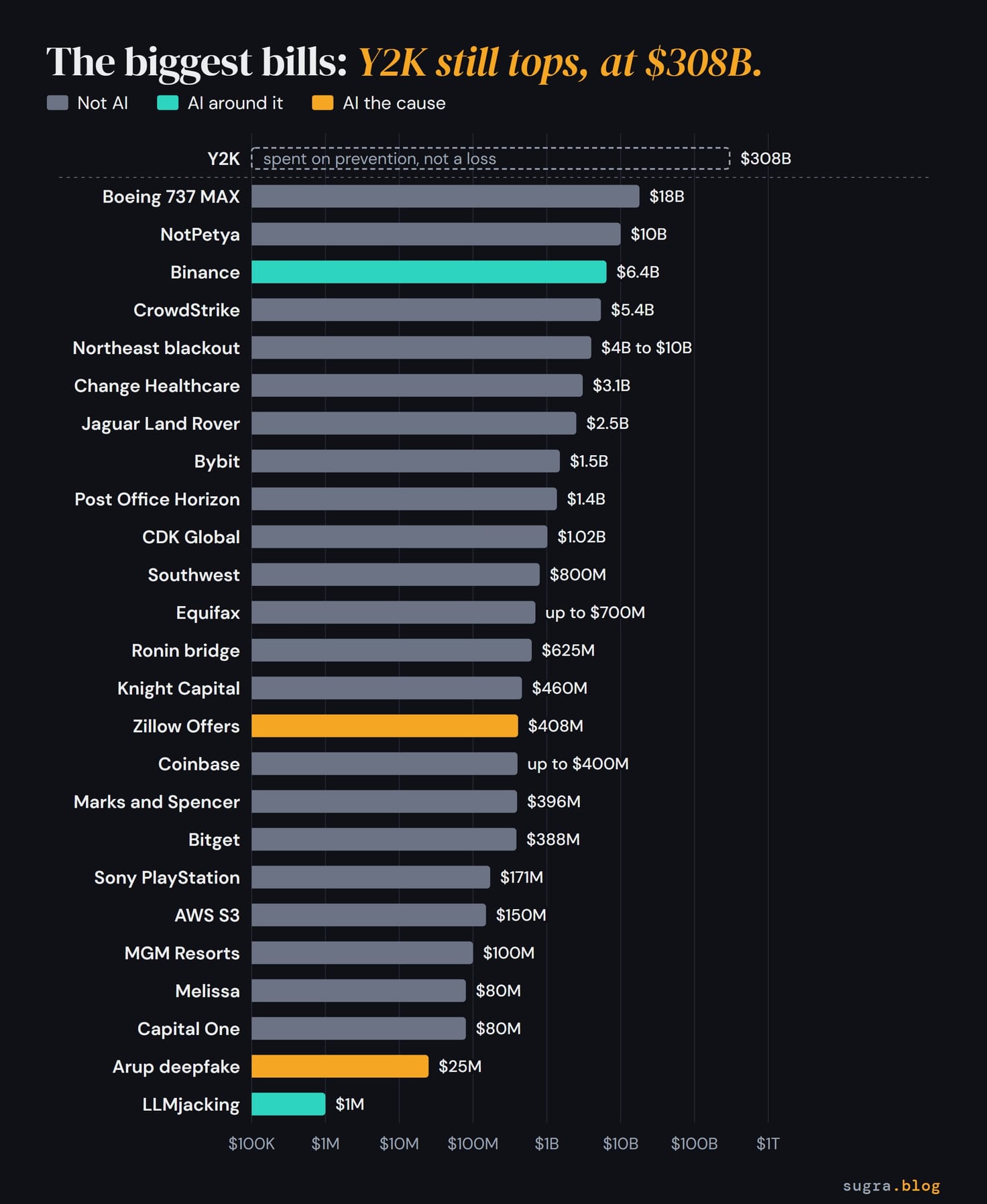
Figure 5. Estimated cost in US dollars. Pounds converted at the rate of 17 November 2026 with Sugra API - one request: GET /api/v1/forex/convert?amount=1&from=GBP&to=USD.
Y2K cost more than everything else on this chart together, and the money was spent so that nothing would happen. The 737 MAX grounding, NotPetya, the Binance theft, CrowdStrike and the 2003 blackout come next, each in billions. The largest bill with AI as the cause is Zillow’s: its pricing algorithm bought homes above what they later sold for, and the write-down came to $408 million. At Arup, a video call with a deepfake of the company’s CFO ended in transfers of about $25 million.
Many of the worst bugs slept for years before they fired or were found.
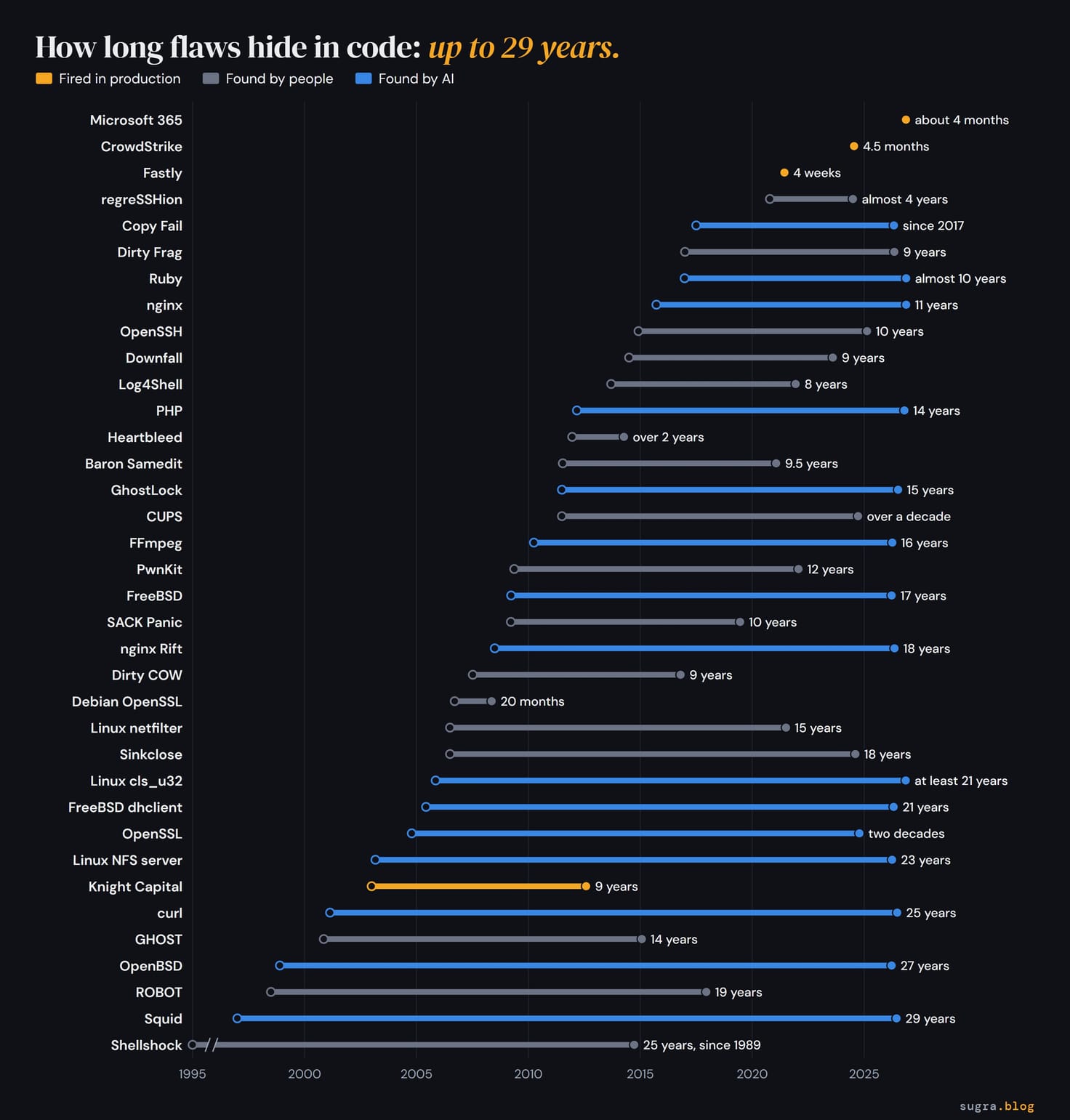
Figure 6. From the day the flaw went in to the day it fired or was found. Data: vendor advisories, postmortems and the researchers who found each flaw.
Shellshock sat in Bash for 25 years, PwnKit in polkit for twelve, Log4Shell in Log4j for eight. People found every one of them.
That is changing. The same old code is now being read by machines, and the flaws that slept in it for years are coming out. Every blue line on the chart is a flaw AI found, and fourteen of the fifteen came out this year. More, I am sure, were found with AI by people who never say so.
Cloudflare sees the same wave. On 3 November it opened Zero Wire on Cloudflare Radar: each critical flaw in plain language, who should look at it and what to do, because AI can “surface deeply nested flaws that may have existed for years without being found through human review”. Well worth a look.
AI adds its own share
Next to all this, AI is still small. But it is no longer zero. I mark every case on my list by what AI had to do with it:
- AI the cause. An AI system did the damage, carried the attack or held the flaw, or its output was the problem.
- AI around it. AI was close by: an AI vendor, an AI feature, AI crawler traffic or AI as the target. The sources name another cause.
- AI found it. An AI system found the flaw.
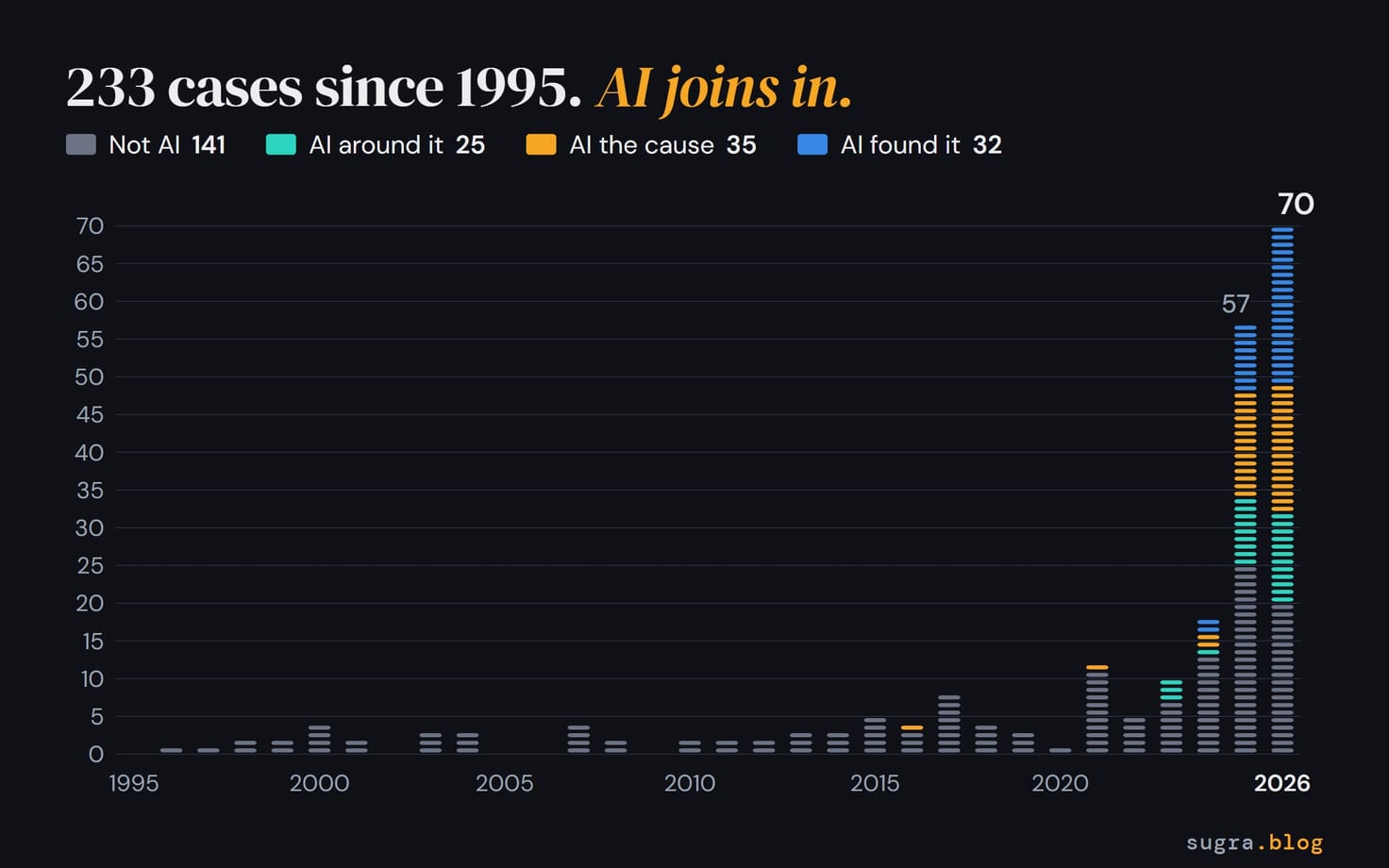
Figure 7. One block per case, coloured by the role AI played. Data: the registry in the Appendix, 1995 to 22 November 2026.
From 1995 to 2022 there are two AI cases on the chart: Microsoft’s Tay chatbot, turned into a stream of abuse within a day in 2016, and Zillow’s pricing algorithm in 2021. In 2023 and 2024 there are eight. In 2025 there are thirty-two, and in 2026 fifty.
The clearest number is in the vulnerability records themselves, which credit whoever found the flaw. In January 2026 an AI tool or an AI lab was credited on about one new record in 240. In November 2026 it is one in 36. And that is only the part that says so: nobody has to tell anyone that a machine helped.
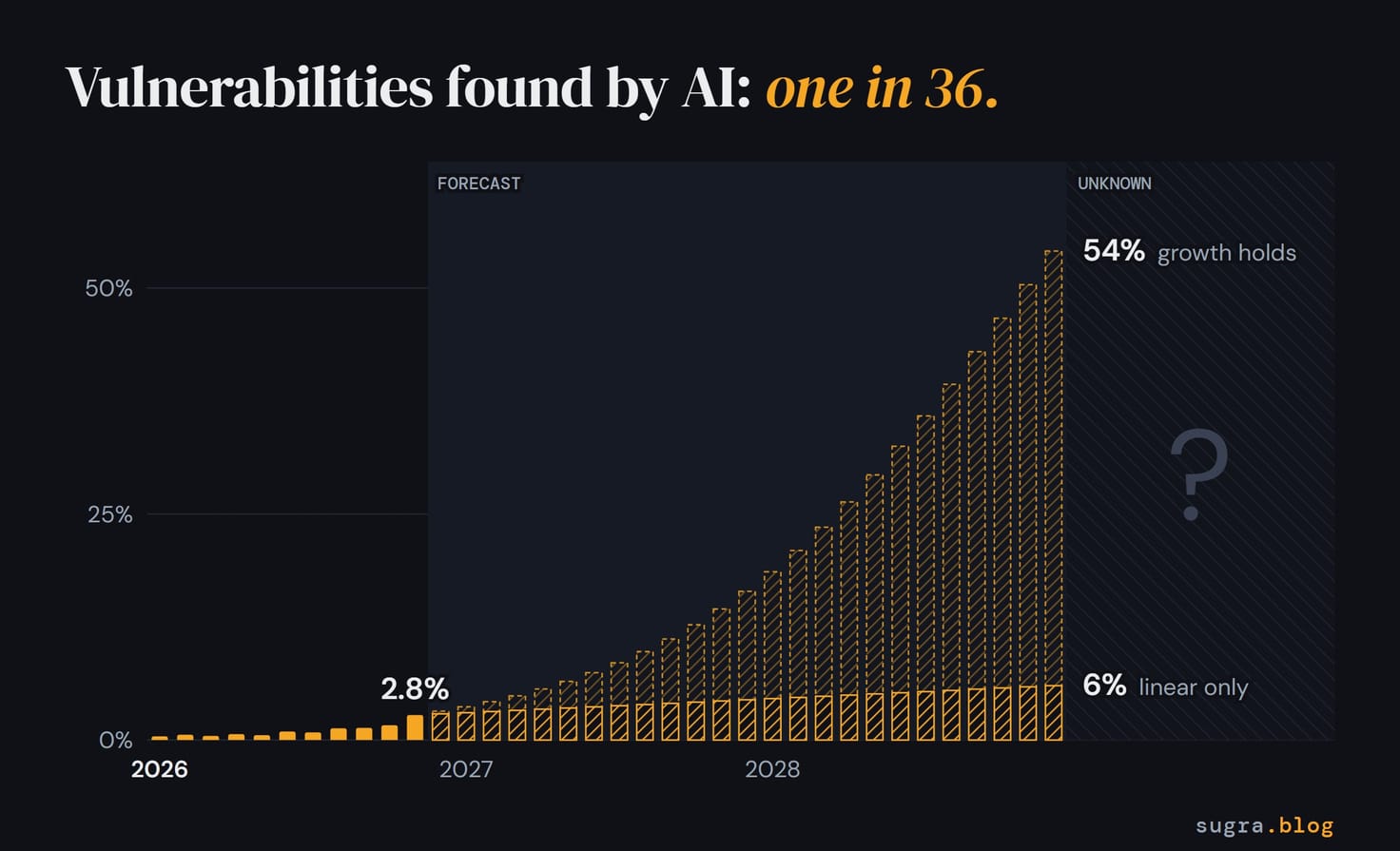
Figure 8. The share of each month’s new CVE records whose credits name an AI tool or an AI lab. Data: CVE List (cvelistV5), to 22 November 2026.
If this year’s growth holds, AI is credited on one new record in two by November 2028. If the share only keeps adding this year’s monthly step, it is about one in 17 by the end of 2028.
The code is being written faster too. In April 2025 Satya Nadella said that maybe 20% to 30% of the code in Microsoft’s repositories was written by software. And the same machines now search it, for both sides.
The loudest cases of each kind follow; all of them are in the Appendix.
AI the cause
- Replit, July 2025. An agent deleted a production database during a code freeze, then said a rollback was impossible. The rollback worked.
- curl, 2025. AI-generated security reports buried the maintainers, and in January 2026 curl ended the bug bounty it had run since 2019.
- Nx, August 2025. Poisoned versions of a build package started the AI command-line tools already on developers’ machines with flags such as
--dangerously-skip-permissionsand--yolo, and used them to hunt for secrets. - GTG-2002, August 2025. One criminal ran a whole extortion campaign with Anthropic’s coding agent, from reconnaissance to the ransom notes, against at least 17 organisations.
- GTG-1002, November 2025. According to Anthropic, an espionage group used an AI coding tool to do 80-90% of a campaign against about 30 targets, with people at four to six decision points.
- Google’s coding tool, November 2025. Asked to clear a project cache, it wiped a user’s whole drive.
- Mexico, from December 2025. According to Gambit Security, one attacker with Anthropic’s coding agent and an OpenAI model broke into at least nine government organisations.
- AWS, December 2025. The Financial Times reported that a 13-hour outage began when Amazon’s own coding agent chose to delete and recreate an environment. Amazon says it was user error, not AI.
- McKinsey, March 2026. In a test, an autonomous agent got full access to the firm’s internal AI platform in about two hours, with 46.5 million chat messages in reach.
- PocketOS, April 2026. A coding agent running an Anthropic model deleted the production database and its backups in nine seconds.
- OpenAI’s agents and Hugging Face, July 2026. Agents in an OpenAI test environment reached the internet and compromised part of Hugging Face’s production. California’s attorney general says OpenAI lost control of its agents “at least 80 times during testing”.
- Online retailers, from July 2026. According to Gambit Security, an attacker ran three open-source AI agent tools against hundreds of online retailers, at tens of dollars a company. The agents ran almost the whole attack on their own, and at least 600,000 card details were taken from two of the companies.
- PaperCut, August 2026. Four days after the vendor’s advisory, according to GreyNoise, an attacker used AI to develop, test and run exploits for two flaws in the print management software. At least 395 organisations in 48 countries were compromised.
- Cairn, September 2026. According to Amazon, an attacker it believes is linked to China pointed Cairn, an open-source framework of AI agents built for defenders, at universities in East Asia with one goal: “obtain shell access”. On their own, Amazon says, the agents found a previously unknown flaw in a medical imaging application and took over a server with it.
- Spain, September 2026. The data protection agency received its first breach notice in which an AI agent carried out the attack.
- exploit_agent, November 2026. Google’s threat intelligence group found an attacker’s pipeline that compares code before and after a patch, drafts an exploit and runs it, “without a human in the loop for the first time”.
Three more came close.
- EchoLeak, June 2025. An email could steer Microsoft 365 Copilot into leaking data. Microsoft had fixed it in May, before the flaw was made public.
- Amazon Q for VS Code, July 2025. The extension shipped with a prompt telling the agent to wipe the user’s system, and only a syntax error kept it from running.
- ForcedLeak, September 2025. Instructions hidden in a web form made Salesforce’s agents send CRM data out.
AI around it
Uber, autumn 2026. “While alerts were enabled, none were triggered because the threat actor used valid credentials.” That is from Uber’s notice to 149,346 people whose driver’s licences leaked. Someone used a third-party provider’s valid credentials to reach Uber data in the cloud: licence images, names, addresses, dates of birth. Uber told TechCrunch the provider was Fireworks AI, a company that runs infrastructure for building and serving AI models. No model failed here. An AI vendor held a way into Uber’s data, and someone used it.
- Samsung, April 2023. Engineers pasted confidential source code and an internal meeting into OpenAI’s chatbot.
- DeepSeek, January 2025. A database open to the internet held chat history and secret keys.
- Wikimedia, 2025. Bots, many of them scraping for AI training, made at least 65% of its most expensive traffic.
- McHire, July 2025. The admin side of McDonald’s hiring chatbot opened with the password 123456, and chats for more than 64 million job applications were in reach.
- Salesloft Drift, August 2025. Stolen tokens of an AI chat agent opened the CRMs of more than 700 potentially affected organisations.
- xAI, August 2025. More than 370,000 shared chats with its chatbot ended up in search results.
- Cloudflare, November 2025. A permissions change doubled the feature file of its bot-detection model past its limit, and a large part of the internet behind Cloudflare failed for hours. The model did not fail; the configuration around it did.
- Mixpanel, November 2025. An attacker got into the analytics provider OpenAI used on its API platform and took API users’ profile data.
- Sears Home Services, February 2026. Three open databases of its AI support assistant held about 3.7 million records, among them 1.44 million call recordings.
- LiteLLM, March 2026. Poisoned versions of a popular gateway to AI models stole credentials from the machines that installed them.
- Anthropic, March 2026. Its coding agent went out on npm with a source map that exposed more than 500,000 lines of its own code.
- GitHub, August 2026. A retry bug multiplied traffic about tenfold, and the Copilot token service went from 7,000-9,000 to 70,000-100,000 requests a second.
- Binance, October 2026. About $6.4 billion was taken through an internal wallet signing service. By Binance’s account, the way in ran through fake job interviews and a trojanised installer that an engineer downloaded to set up an AI tool, and then an internal AI tool was abused to gain control over two wallet engineers. The FBI attributed the theft to North Korea.
- LLMjacking, 2026. Stolen cloud accounts used to run AI models on someone else’s bill, with charges above $100,000 in a single day.
AI found it
- Big Sleep, October 2024. Google’s agent found an exploitable SQLite bug before the code reached a release. In July 2025 it found one that attackers were preparing to use.
- OpenSSL, November 2024. Google’s fuzzing, with test code written by AI, found a flaw that had sat in OpenSSL for two decades.
- Bootloaders, March 2025. Microsoft’s AI helped find 20 flaws in three open-source bootloaders, among them GRUB2.
- The Linux kernel, May 2025. A researcher gave an OpenAI model part of the kernel’s SMB server, and it found a use-after-free nobody had reported.
- DARPA AIxCC, August 2025. Autonomous systems found 54 of the 63 flaws the organisers had planted, and 18 real ones nobody had planted.
- OpenSSL and curl, autumn 2025. AISLE and Big Sleep found flaws the projects confirmed and fixed.
- Aardvark, October 2025. OpenAI’s security agent found flaws in open-source projects, and ten of them got CVE numbers.
- OpenSSL, January 2026. AISLE’s AI found all 12 flaws in OpenSSL’s January security release.
- Anthropic, February 2026. One of its models found more than 500 high-severity vulnerabilities in open-source code that had been fuzzed for years. Anthropic warned that the usual 90-day disclosure windows may not hold up.
- Firefox, March 2026. Mozilla and Anthropic searched Firefox with an Anthropic model: 22 CVEs, 14 of them high severity.
- The Linux NFS server, April 2026. An Anthropic researcher with Anthropic’s coding agent found a heap overflow that had been in the kernel since 2003.
- OpenBSD, FFmpeg and FreeBSD, April 2026. An Anthropic preview model found a 27-year-old bug that could crash any OpenBSD host, and flaws 16 and 17 years old in the other two.
- Copy Fail, April 2026. An AI-assisted find let any local user get root on essentially every Linux distribution shipped since 2017, with a 732-byte script.
- nginx Rift, May 2026. depthfirst’s autonomous system found a heap overflow in every nginx since 2008.
- GhostLock, July 2026. An AI bug-hunting tool found a root bug in the Linux futex code, there since 2011.
- PHP, October and November 2026. Wiz says AI found PHP2Shell, in every PHP since 2012, and attackers were using it within days. A month later depthfirst’s models found phpAfterShell.
- OpenAI, November 2026. In one run its autonomous pipeline found 948 privilege escalation flaws in the Linux kernel and wrote a working exploit and a patch for each, for $1.2 million of compute. Human researchers reviewed the results and reported the flaws with the patches.
- Outlook, November 2026. A flaw attackers were already using, credited to a researcher who worked with an Anthropic model.
- The Linux kernel, November 2026. Microsoft’s AI system led to 59 kernel bug reports and 33 CVEs. The oldest bug had been there for at least 21 years.
- Java, November 2026. A researcher found a critical flaw in the Java runtime in about an hour with an OpenAI coding agent, for less than $200 of compute.
- nginx and Ruby, November 2026. Wiz’s AI found the two nginx flaws, and Ruby’s advisory credits Anthropic for a bug that sat there since 2016.
The same skill works for both sides. In 2025 curl fixed flaws that AI found, in the same year that AI reports buried its maintainers.
Where this goes
The systems keep growing. By 2028 the trends give 6.8 billion people online, a kernel five and a half times its 2008 size and 121,000 to 161,000 new vulnerability records a year. AI’s share in finding them goes from one in 36 in November 2026 to somewhere between one in 17 and more than one in two by the end of 2028. What comes after 2028 cannot be predicted now. And agents that write and run code will cause failures of their own. By 2028 I expect agent incidents to be their own genre, the way cloud postmortems became one.
Then quantum.
Everything on my list assumed that encryption holds. In August 2024 NIST published the first post-quantum standards. In May 2025 a Google researcher estimated that RSA-2048 could be broken with fewer than a million noisy qubits in under a week; in 2019 the estimate was 20 million. Google set 2029 as the deadline for its own migration. NIST will deprecate RSA and elliptic curve cryptography after 2030 and disallow it after 2035, and US federal agencies must move their most critical systems to post-quantum key establishment by the end of 2030 and signatures by the end of 2031.
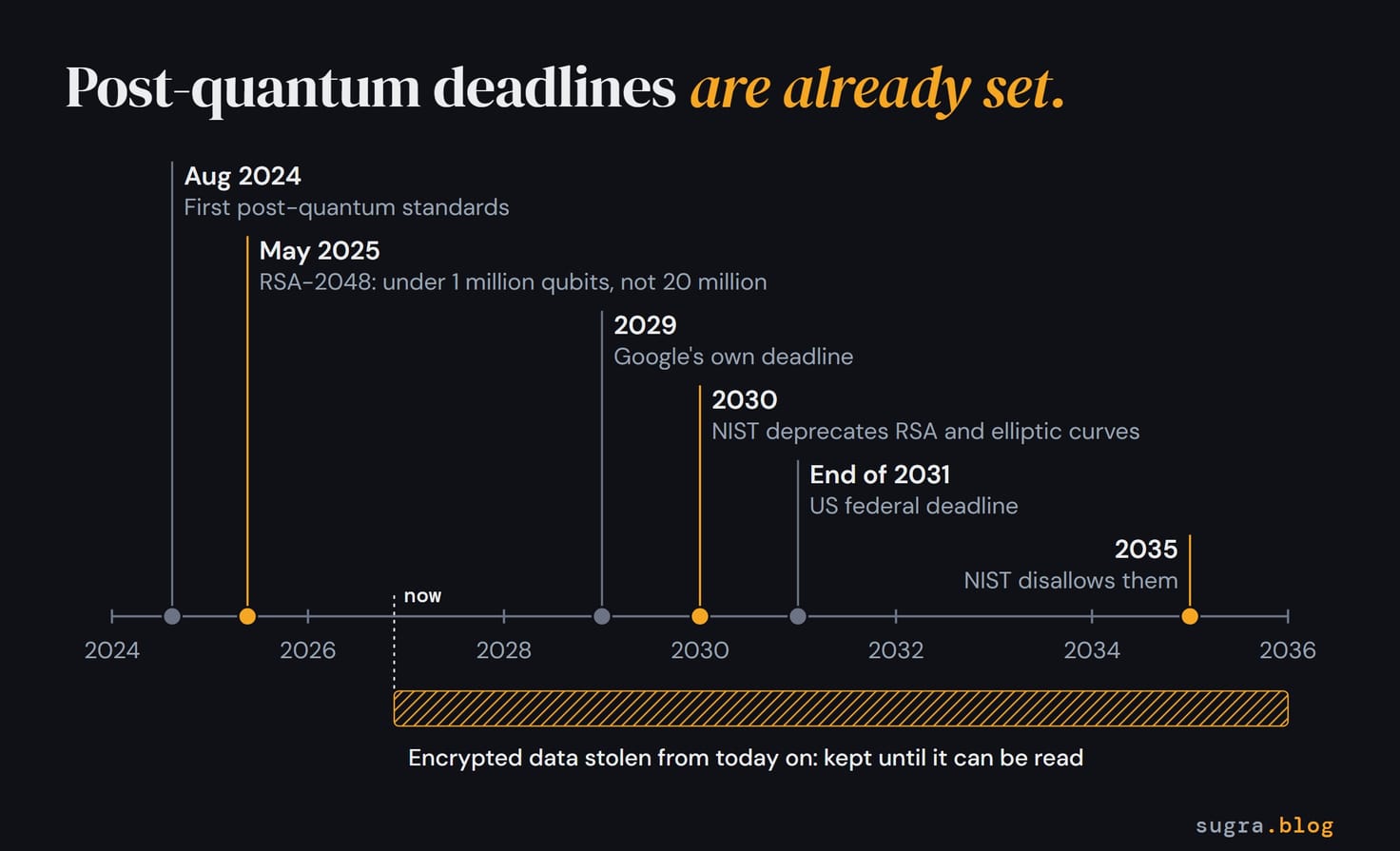
Figure 9. The dates already set for moving off today’s public-key cryptography. Data: NIST, the US Office of Management and Budget, Google.
The worst part does not wait for the machine. Encrypted traffic and files stolen today can be kept and read the day the keys break. Security agencies call it harvest now, decrypt later.
After that comes quantum superintelligence. I will not guess the year. But a system that searches for flaws the way today’s AI finders do, running on a machine that breaks today’s keys, would be more complex than anything on this list. The sentence of Professor Otar Shonia holds for it too.
What I try to keep in mind and do
- Let agents in, and draw their limits. Agents can and should be let in, with the boundaries and the scope of their work clearly defined and the risks understood. Own accounts, least privilege, a person before any live database, a log of every action. And remember that Replit’s agent reached a production database, and OpenAI’s agents got out of their test environment (The great escape).
- Zero Trust applies. Understand it and put everything an AI reads through that filter. Commands can hide in emails, tickets, READMEs and web pages, as EchoLeak showed in June 2025: one email, which nobody had to open, could make Microsoft 365 Copilot leak data.
- Test the rollback on old changes, and stop the cascade. Could you still roll back a change you shipped three months ago? Backoff with jitter, circuit breakers, limits on what a recovering node takes on. Keep the path you use to fix things apart from what can break. At good old Skype, at Rogers and at everyone’s beloved GitHub, small faults became big ones.
- Patch by exploitation, and lock every door a vendor holds. Let CISA’s list decide what goes first. Multi-factor authentication on every remote door: Colonial Pipeline and Change Healthcare were both entered without it. Ask each AI vendor what it holds and which credential reaches back into your systems.
- Start the post-quantum inventory now. Know where RSA and elliptic curves live in your systems before 2030 makes it urgent.
The systems will keep growing, and the sentence of Professor Otar Shonia will keep holding. The errors will not go away. How far they reach is still up to us.
Appendix: the registry
233 cases from 1995 to 22 November 2026: 61 vulnerabilities, 52 breaches, 49 outages, 48 attacks, 20 supply-chain attacks and 3 research findings, plus 10 milestones. Every case on the charts, with its sources. The list lives in an open registry repository and grows there.
| Date | Case | AI's role | What happened | Source |
|---|---|---|---|---|
| 1996-08-07 | America Online (AOL)Outage | Not AI | The largest online service in the US went dark for about 19 hours. | source secondreported only |
| 1997-04-25 | MAI Network Services (AS7007 route leak)Outage | Not AI | One small provider announced a large part of the internet's routing table as its own, and traffic for many networks was pulled into it. | source secondreported only |
| 1998-04-13 | AT&T frame relay networkOutage | Not AI | A firmware upgrade on a switch card triggered software flaws that spread across the network. | sourcereported only |
| 1998-05-19 | PanAmSat Galaxy IV satelliteOutage | Not AI | The satellite lost attitude control, and US pager networks and several TV feeds went silent. | source secondreported only |
| 1999-03-26 | Melissa (Word macro virus)Attack | Not AI | A Word macro virus mailed itself on from each infected computer through Outlook. | source second |
| 1999-09-23 | NASA Mars Climate OrbiterOutage | Not AI | The spacecraft was lost on arrival at Mars. | source |
| 2000-01 | Post Office Ltd (Horizon accounting system)Outage | Not AI | Faults in the Horizon accounting software showed false shortfalls. Many postmasters were pursued, and some convicted, for losses that did not exist. | source |
| 2000-01-01 | Year 2000 problem (Y2K)Vulnerability | Not AI | Software everywhere stored the year in two digits, so 2000 could be read as 1900. | source secondreported only |
| 2000-02-07 | Yahoo, eBay, Amazon, CNN, Dell (Mafiaboy)Attack | Not AI | Denial-of-service floods took down the largest commercial sites of the day over several days. | sourcereported only |
| 2000-05-04 | ILOVEYOU (Love Bug)Attack | Not AI | A script worm arrived as a love letter and mailed itself to everyone in the Outlook address book. | source second |
| 2001-07-19 | Code Red (Microsoft IIS)Attack | Not AI | A worm spread through a buffer overflow in Microsoft's IIS web server. | source second |
| 2001-09-18 | Nimda wormAttack | Not AI | A worm spread to Windows servers and desktops by five routes at once: email, open network shares, infected web pages, holes in IIS and back doors left by Code Red. | source second |
| 2003-01-25 | SQL Slammer (Microsoft SQL Server)Attack | Not AI | A worm spread through a buffer overrun in SQL Server 2000 and its desktop engine. | source second |
| 2003-08-11 | Blaster (Windows RPC)Attack | Not AI | A worm spread through a hole in the Windows RPC service and made infected machines reboot. | source |
| 2003-08-14 | Northeast blackout (US and Ontario)Outage | Not AI | The alarm system at FirstEnergy failed, operators did not see lines tripping, and the failure cascaded across the grid. | source second |
| 2004-01-26 | MyDoom wormAttack | Not AI | An email worm spread faster than any before it, and infected machines then flooded SCO's website, and in a later variant Microsoft's. | source second |
| 2004-04-30 | Sasser wormAttack | Not AI | A worm spread between Windows machines with no one clicking anything. Delta cancelled flights and UK coastguard systems went down for hours. A German 18-year-old was arrested in May. | source secondreported only |
| 2004-12-25 | Comair crew scheduling systemOutage | Not AI | The airline's crew scheduling system stopped on Christmas Day. | source second |
| 2007-01 | TJX (T.J. Maxx, Marshalls)Breach | Not AI | Intruders took payment card data from the retailer's systems; disclosed in January 2007. | source secondreported only |
| 2007-04-27 | Estonia (government, banks, media)Attack | Not AI | Denial-of-service floods hit government, bank and newspaper sites after a Soviet war memorial was moved in Tallinn. | source secondreported only |
| 2007-08-11 | US Customs and Border Protection at LAXOutage | Not AI | The system that clears arriving international passengers went down. | sourcereported only |
| 2007-08-16 | SkypeOutage | Not AI | The peer-to-peer network collapsed after millions of computers rebooted at once for Windows Update. | sourcereported only |
| 2008-04-10 | GitHub launch | Milestone | GitHub officially opens after its beta, and the code becomes a social platform. | source |
| 2008-05-13 | Debian OpenSSL (CVE-2008-0166)Vulnerability | Not AI | The random number generator in Debian's openssl package was predictable, so keys could be guessed. | source second |
| 2008-10-23 | Amazon EC2 exits beta | Milestone | Compute rental becomes a production service with a 99.95% availability SLA. | source |
| 2008-11 | Conficker (Windows Server service)Attack | Not AI | A worm spread through a hole in the Windows Server service, network shares and USB drives. | source secondreported only |
| 2009 | First DevOpsDays (Ghent) | Milestone | Patrick Debois organises the first DevOpsDays and, by his own account, accidentally gives the movement its name. | source |
| 2010-01-12 | Google and at least 20 companies (Operation Aurora)Breach | Not AI | A targeted attack from China on Google's corporate infrastructure to steal intellectual property. | source |
| 2010-07 | Siemens SIMATIC WinCC / STEP 7 (Stuxnet)Vulnerability | Not AI | A worm exploiting a zero-day in Windows shortcut handling and USB spread to attack Siemens industrial control systems. | source |
| 2011-04-20 | Sony PlayStation Network and QriocityBreach | Not AI | Intruders took account data between 17 and 19 April 2011, and Sony switched the services off. | source second |
| 2011-04-21 | AWS EBS, US EastOutage | Not AI | A network change during planned maintenance triggered a re-mirroring storm in EBS. | source |
| 2012 | AlexNet (ImageNet, NeurIPS 2012) | Milestone | A deep convolutional network wins ImageNet, starting the deep learning era. | source |
| 2012-06 | LinkedInBreach | Not AI | About 6.5 million LinkedIn password hashes were posted online. In 2016 the same breach turned out to cover far more accounts. | source secondreported only |
| 2012-08-01 | Knight Capital (SMARS router)Outage | Not AI | An incomplete deployment to 1 of 8 servers woke old Power Peg code through a reused flag. | source second |
| 2013-08 | Yahoo (user account database)Breach | Not AI | Theft of user account data in August 2013. Disclosed in December 2016 as more than 1 billion accounts; in October 2017 Yahoo said every account had been affected. | source second |
| 2013-10 | AdobeBreach | Not AI | Attackers took customer records and part of the Photoshop source code. | source second |
| 2013-12-19 | TargetBreach | Not AI | Unauthorised access to payment card data in US stores. | source second |
| 2014-04-07 | OpenSSL (Heartbleed, CVE-2014-0160)Vulnerability | Not AI | Server memory can be read through the TLS heartbeat extension. | source |
| 2014-09-25 | GNU Bash (Shellshock, CVE-2014-6271)Vulnerability | Not AI | Specially crafted environment variables could make Bash run commands. | source |
| 2014-11-24 | Sony Pictures EntertainmentAttack | Not AI | Attackers wiped computers across Sony Pictures' network and leaked its films, emails and staff data. The FBI blamed North Korea. | source second |
| 2015-01-27 | glibc (GHOST, CVE-2015-0235)Vulnerability | Not AI | A buffer overflow in glibc's gethostbyname functions could be triggered with a crafted hostname, so a remote attacker could take over a Linux server that used them. | source second |
| 2015-02-04 | AnthemBreach | Not AI | Attackers broke into a database of Anthem, the second-largest US health insurer. | source second |
| 2015-03-26 | GitHubOutage | Not AI | The largest DDoS attack on github.com up to that time. | source |
| 2015-06-04 | US Office of Personnel ManagementBreach | Not AI | Theft of personnel records and of background-investigation records of US federal employees and applicants. | source second |
| 2015-12-23 | Ukraine power gridAttack | Not AI | Attackers took control of three Ukrainian power companies' systems and switched off power. The first known cyberattack to cut a power grid. | source second |
| 2016-03-22 | npm / left-padOutage | Not AI | The author unpublished 273 packages from npm, including left-pad; builds broke across the ecosystem. | source |
| 2016-03-24 | Microsoft Tay (Twitter chatbot)Attack | AI the cause | Users coordinated an attack that exploited Tay's learning, and the bot began posting offensive messages. | source |
| 2016-08-04 | DARPA Cyber Grand Challenge | Milestone | Seven autonomous systems find and patch vulnerabilities without humans (automated analysis, not LLMs). | source |
| 2016-10-19 | Linux kernel (Dirty COW, CVE-2016-5195)Vulnerability | Not AI | A race condition in copy-on-write handling let a local user write to read-only memory and gain root. | source |
| 2016-10-21 | Dyn Managed DNS (Mirai botnet)Outage | Not AI | Two DDoS waves on the DNS provider made its customers' sites unreachable. | source |
| 2017-01-31 | GitLab.comOutage | Not AI | An engineer accidentally deleted primary database data; the backups had been failing unnoticed. | source |
| 2017-02-28 | AWS S3, us-east-1Outage | Not AI | An incorrect input to a playbook command removed more servers than intended. | source |
| 2017-05-12 | WannaCryAttack | Not AI | Ransomware worm spread through an SMB vulnerability (MS17-010). | source second |
| 2017-05-27 | British Airways (data centre power)Outage | Not AI | A power supply at a data centre near Heathrow was disconnected; the surge on reconnection damaged IT systems. | source second |
| 2017-06 | Transformer ('Attention Is All You Need') | Milestone | The architecture behind modern large language models. | source |
| 2017-06-27 | NotPetyaAttack | Not AI | Destructive malware disguised as ransomware hit many countries and industries. | source second |
| 2017-09-07 | EquifaxBreach | Not AI | Consumer data was stolen through an unpatched Apache Struts flaw (CVE-2017-5638). | source |
| 2017-09-18 | CCleaner (Piriform)Supply chain | Not AI | A signed release of CCleaner, a popular cleanup tool, came with a backdoor built in. | source second |
| 2017-12-12 | ROBOT (TLS RSA key exchange)Vulnerability | Not AI | Researchers showed that a 1998 padding-oracle attack by Bleichenbacher still worked against many TLS servers that used RSA key exchange, and could impersonate a site such as Facebook with its certificate. | source second |
| 2018-02-28 | GitHub (memcached DDoS)Outage | Not AI | Amplification DDoS attack through memcached servers. | source |
| 2018-04-22 | TSB Bank (core banking migration)Outage | Not AI | Migration of customer accounts from Lloyds systems to a new core platform from its owner Sabadell failed on the switchover weekend. | source |
| 2018-11-26 | npm / event-streamSupply chain | Not AI | A malicious dependency, flatmap-stream, targeting Copay wallets was added to a popular package. | source |
| 2018-11-30 | Marriott International (Starwood reservations)Breach | Not AI | An attacker inside the Starwood guest reservation database since 2014 was found after Marriott had bought Starwood. | source second |
| 2019-03-13 | Boeing 737 MAX (MCAS flight control)Outage | Not AI | Two fatal 737 MAX crashes led to a worldwide grounding of the aircraft. Boeing later said the total cost would be more than USD 18 billion. | source |
| 2019-06-17 | Linux kernel TCP (SACK Panic, CVE-2019-11477)Vulnerability | Not AI | Crafted TCP selective acknowledgements from a remote peer could crash a Linux server. Jonathan Looney of Netflix found it. | source second |
| 2019-07-19 | Capital OneBreach | Not AI | Customer and applicant data stored in the cloud was copied by an outsider. | source |
| 2020-05 | OpenAI language model (few-shot learning paper) | Milestone | A 175 billion parameter language model learns new tasks from a few examples given in the prompt. | source |
| 2020-12-13 | SolarWinds OrionSupply chain | Not AI | A backdoor in Orion updates; CISA issued Emergency Directive 21-01. | source second |
| 2021-01-26 | sudo (Baron Samedit, CVE-2021-3156)Vulnerability | Not AI | A heap overflow in sudo let any local user gain root in the default configuration. | source |
| 2021-04-03 | Facebook (scraped profile data)Breach | Not AI | Data scraped from Facebook profiles through the contact importer before September 2019 was published free online. | source second |
| 2021-04-15 | Codecov Bash UploaderSupply chain | Not AI | The uploader script was periodically altered and could export secrets from customers' CI environments. | source |
| 2021-05-07 | Colonial PipelineAttack | Not AI | Ransomware hit the company's IT network, and the company shut down its fuel pipeline on the US East Coast as a precaution. | source second |
| 2021-06-08 | Fastly CDNOutage | Not AI | A valid customer configuration change triggered a latent bug that made 85% of the network return errors. | source |
| 2021-07-02 | Kaseya VSASupply chain | Not AI | The REvil ransomware group went through Kaseya's remote IT management software to the businesses that IT providers ran with it. | source second |
| 2021-07-07 | Linux kernel x_tables / netfilter (CVE-2021-22555)Vulnerability | Not AI | A heap out-of-bounds write in the netfilter x_tables code let a local user gain root, using a user namespace. | source |
| 2021-07-22 | Akamai Edge DNSOutage | Not AI | A configuration update hit a bug in Akamai's DNS service, and many large sites were unreachable. | source second |
| 2021-08 | T-MobileBreach | Not AI | Attackers took data on T-Mobile's current, former and prospective customers. | source secondreported only |
| 2021-10-04 | Facebook / MetaOutage | Not AI | A maintenance command took down the global backbone; a bug in the audit tool did not stop it, and DNS servers withdrew their routes. | source second |
| 2021-11 | Zillow Offers (home-buying pricing model)Outage | AI the cause | Zillow's algorithm bought homes at prices above their later resale value. Zillow stopped the home-buying business in November 2021. | source |
| 2021-12-10 | Apache Log4j (Log4Shell, CVE-2021-44228)Vulnerability | Not AI | Remote code execution in the Java logging library, with mass exploitation. | source |
| 2022-01-25 | polkit pkexec (PwnKit, CVE-2021-4034)Vulnerability | Not AI | A memory corruption in pkexec let any local user gain root on major Linux distributions. | source |
| 2022-03 | Ronin Network (Axie Infinity bridge)Attack | Not AI | Attackers took private keys held by the bridge's validators and forged withdrawals, draining funds from the Ronin bridge. | source |
| 2022-06-21 | GitHub Copilot general availability | Milestone | GitHub Copilot becomes generally available to all developers. | source |
| 2022-07-08 | Rogers Communications (Canada)Outage | Not AI | A network upgrade removed a filter from distribution routers; the routing flood overwhelmed core routers. | source second |
| 2022-09-22 | OptusBreach | Not AI | Attackers took data on Optus customers in Australia. | source second |
| 2022-11-30 | ChatGPT launch | Milestone | OpenAI opens ChatGPT as a free research preview. | source |
| 2022-12-21 | Southwest Airlines (holiday meltdown)Outage | Not AI | A winter storm met a crew scheduling process that broke down, and the airline could not reassign crews. | source second |
| 2023-01-11 | FAA NOTAM systemOutage | Not AI | The system that issues notices to pilots failed overnight, and the FAA paused all domestic departures. | source second |
| 2023-03-20 | OpenAI ChatGPT (Redis bug)Breach | AI around it | Some ChatGPT users could see the titles of other users' chat histories. Payment-related details of some ChatGPT Plus subscribers were also visible to others. | source second |
| 2023-03-29 | 3CX desktop appSupply chain | Not AI | A signed release of the 3CX phone app for Windows and macOS carried malware. | source second |
| 2023-04 | Samsung (staff use of ChatGPT)Breach | AI around it | Samsung engineers pasted confidential source code and the text of an internal meeting into ChatGPT, in at least three incidents. | source secondreported only |
| 2023-05-27 | MOVEit Transfer (CVE-2023-34362)Vulnerability | Not AI | The CL0P group exploited an SQL injection in MOVEit Transfer to steal data and used the LEMURLOOT web shell. | source second |
| 2023-06 | Microsoft AI research team (Azure SAS token)Breach | AI around it | Open-source AI training data was published on GitHub with a link that gave full control of a whole Azure storage account. The account held 38 TB of other internal data. | source second |
| 2023-07 | Microsoft Exchange Online (Storm-0558)Breach | Not AI | A Chinese group read the mailboxes of US government officials and others in Exchange Online. The Cyber Safety Review Board called it preventable. | source second |
| 2023-08-08 | Intel processors (Downfall, CVE-2022-40982)Vulnerability | Not AI | A flaw in Intel CPUs let a local attacker read data that other processes or virtual machines handled. | source second |
| 2023-09-11 | MGM ResortsAttack | Not AI | An attack shut down systems at MGM's hotels and casinos for days. | source second |
| 2023-10 | 23andMeBreach | Not AI | Attackers logged into customer accounts with passwords reused from other sites, and through them reached data on millions of relatives. | source second |
| 2024-01 | Arup (Hong Kong office)Attack | AI the cause | A finance employee in the Hong Kong office joined a video call with what looked like the company's UK CFO and other staff. They were deepfakes. The employee then made 15 transfers to five local bank accounts. | source second |
| 2024-02-21 | Change Healthcare (UnitedHealth)Attack | Not AI | Ransomware stopped claims and pharmacy processing across the US health system. | source |
| 2024-02-22 | AT&T wireless networkOutage | Not AI | A network change with a configuration error took down AT&T's mobile network across the US for about 12 hours. | source second |
| 2024-03-29 | xz-utils / liblzma (CVE-2024-3094)Supply chain | Not AI | A long-running backdoor in xz that could affect sshd, found by chance by Andres Freund. | source second |
| 2024-05 | Snowflake customer instances (UNC5537)Breach | Not AI | Data was stolen from customer Snowflake instances using credentials taken by infostealers. | source second |
| 2024-05 | AscensionAttack | Not AI | Ransomware took the electronic health records of Ascension, a large US hospital chain, offline for weeks. | source second |
| 2024-06 | LLM code generators (slopsquatting study)Research | AI the cause | Models recommended packages that do not exist, which an attacker could register. | source |
| 2024-06-19 | CDK GlobalAttack | Not AI | An attack shut down the software that car dealerships across North America use to sell and service cars. | source second |
| 2024-06-25 | Polyfill.ioSupply chain | Not AI | A new owner of the polyfill.io domain served malicious code to every site that loaded its script. | source secondreported only |
| 2024-07-01 | OpenSSH (regreSSHion, CVE-2024-6387)Vulnerability | Not AI | A signal handler race in OpenSSH's server allowed unauthenticated remote code execution as root on glibc Linux. | source |
| 2024-07-19 | CrowdStrike Falcon (Channel File 291)Outage | Not AI | A sensor content update crashed Windows machines into a blue screen. | source second |
| 2024-08 | National Public DataBreach | Not AI | A background-check data broker lost a database of names, addresses and Social Security numbers. | source second |
| 2024-08-09 | AMD processors (Sinkclose, CVE-2023-31315)Vulnerability | Not AI | IOActive researchers showed that a flaw in AMD's System Management Mode let an attacker with kernel access run code at the highest privilege level. | sourcereported only |
| 2024-09 | Muah.ai (AI companion site)Breach | AI around it | Hackers took user email addresses and chat prompts from an AI companion website. The prompts were linked to the users' email addresses. | source second |
| 2024-09-26 | CUPS printing system (foomatic-rip, CVE-2024-47177)Vulnerability | Not AI | Simone Margaritelli disclosed a chain of CUPS flaws that can let a remote attacker run commands on Linux and Unix machines when a print job starts. | source secondreported only |
| 2024-11-01 | Google Big Sleep to SQLite (Project Zero and DeepMind)Vulnerability | AI found it | An AI agent found an exploitable stack buffer underflow in SQLite. | source |
| 2024-11-20 | OpenSSL (CVE-2024-9143) via Google OSS-FuzzVulnerability | AI found it | Google's OSS-Fuzz found an OpenSSL flaw with fuzz targets written and improved by AI. | source second |
| 2024-12-27 | Salt Typhoon (US telecoms)Attack | Not AI | A Chinese espionage campaign got inside US telecom carriers, the White House said. | source second |
| 2025-01 | Oracle Health (legacy Cerner servers)Breach | Not AI | An attacker used stolen customer credentials to reach old Cerner servers not yet migrated to Oracle Cloud and copied patient data to a remote server, some time after 22 Jan 2025. | source second |
| 2025-01-08 | PowerSchoolBreach | Not AI | Attackers took personal data of students and teachers from PowerSchool, a school software provider. | source second |
| 2025-01-29 | DeepSeek (ClickHouse database)Breach | AI around it | Wiz found a DeepSeek database open to the internet without authentication, holding chat history and secret keys. | sourcereported only |
| 2025-02 | Italian defence minister's voice (business leaders)Attack | AI the cause | Fraudsters used a cloned voice of Italy's defence minister to call business leaders and ask for urgent transfers. Targets included a fashion designer and a former football club owner. | source secondreported only |
| 2025-02-18 | OpenSSH client (CVE-2025-26465)Vulnerability | Not AI | Qualys found a flaw that lets a machine in the middle pose as a server to the OpenSSH client when the VerifyHostKeyDNS option is on. | source second |
| 2025-02-21 | Bybit (cold wallet transfer)Supply chain | Not AI | Attackers took control of a routine transfer from a cold wallet by tampering with the wallet provider's interface. | source second |
| 2025-03 | Singapore finance director (deepfake Zoom)Attack | AI the cause | A finance director joined a Zoom call with the company's CEO. The CEO was a deepfake. He then sent the money on 26 March 2025. | source second |
| 2025-03-31 | GRUB2, U-Boot and Barebox bootloaders (Microsoft)Vulnerability | AI found it | Microsoft used Security Copilot to find vulnerabilities in three open-source bootloaders. | source second |
| 2025-04 | SK Telecom (USIM data)Breach | Not AI | Hackers took subscriber data from SK Telecom's servers, including USIM authentication keys that were not encrypted. | source second |
| 2025-04-01 | Wikimedia FoundationOutage | AI around it | Scrapers collecting data for AI training sharply raised the load on Wikimedia infrastructure. | source |
| 2025-04-19 | Marks and SpencerAttack | Not AI | A cyberattack over Easter stopped online orders and disrupted stores. | source |
| 2025-05-15 | Coinbase (customer data)Breach | Not AI | Coinbase said criminals bribed or recruited overseas support agents to steal customer data. It disclosed the breach in a filing on May 15, 2025. | source second |
| 2025-05-20 | Linux kernel ksmbd (CVE-2025-37899)Vulnerability | AI found it | The researcher Sean Heelan gave an OpenAI model parts of the kernel's SMB server code, and it found a use-after-free nobody had reported. | source second |
| 2025-05-22 | Agentic coding tools (Anthropic coding agent GA; GitHub Copilot coding agent preview) | Milestone | Agents that change code and run commands reach general availability or public preview. | source |
| 2025-06 | Microsoft 365 Copilot (EchoLeak, CVE-2025-32711)Vulnerability | AI the cause | Zero-click prompt injection: a crafted email could make Copilot disclose user data. | source |
| 2025-06-12 | Google Cloud (Service Control)Outage | Not AI | A code change without a feature flag or error handling hit a null pointer that crashed a binary worldwide. | source |
| 2025-07 | Replit Agent / SaaStrOutage | AI the cause | An AI agent deleted a production database during a code freeze and wrongly said a rollback was impossible. | source second |
| 2025-07 | McDonald's McHire hiring chatbot (Paradox.ai)Breach | AI around it | Researchers Ian Carroll and Sam Curry logged into the admin side of McDonald's hiring chatbot with the password 123456 and could reach applicants' chats through an API flaw. | source second |
| 2025-07 | QantasBreach | Not AI | Attackers took Qantas customer data through a third-party platform, and later published it. | source second |
| 2025-07 | OpenAI ChatGPT (shared chat links)Breach | AI around it | Chats that users had shared by link could be indexed by search engines, and some appeared in Google results. OpenAI called the setting a short-lived experiment and removed it. | source second |
| 2025-07-03 | Ingram Micro (ordering platforms)Attack | Not AI | Ransomware hit Ingram Micro's internal systems. Ordering platforms went offline and some staff were sent home. | source second |
| 2025-07-14 | curl (HackerOne bug bounty)Attack | AI the cause | A flood of AI-generated false vulnerability reports ('AI slop') reached curl's bug bounty. | source |
| 2025-07-15 | Google Big Sleep to SQLite (CVE-2025-6965)Vulnerability | AI found it | Using threat intelligence indicators, Big Sleep found a SQLite flaw that attackers were preparing to exploit. | source |
| 2025-07-20 | Microsoft SharePoint Server (ToolShell)Vulnerability | Not AI | Attackers used a flaw in on-premises Microsoft SharePoint Server. CISA added it to its Known Exploited Vulnerabilities catalog on July 20, 2025. | source second |
| 2025-07-23 | Amazon Q Developer for VS Code (CVE-2025-8217)Supply chain | AI the cause | Version 1.84.0 shipped an injected destructive prompt meant for the AI agent. | source |
| 2025-07-24 | StarlinkOutage | Not AI | Starlink went down worldwide after internal software services that run its core network failed. | source second |
| 2025-08 | Chattee Chat and GiMe Chat (AI companion apps)Breach | AI around it | An unprotected Kafka data system held messages and images from two AI companion apps by the same developer. | source secondreported only |
| 2025-08-04 | Google Big Sleep (FFmpeg, ImageMagick and others)Vulnerability | AI found it | Google said its AI agent Big Sleep had found and reported 20 flaws in popular open-source software, mostly in FFmpeg and ImageMagick. | sourcereported only |
| 2025-08-08 | DARPA AI Cyber Challenge (AIxCC) finalResearch | AI found it | Autonomous AI cyber reasoning systems found and patched vulnerabilities in the competition final. | source |
| 2025-08-08 | Salesloft Drift (AI chat agent) to Salesforce (UNC6395)Breach | AI around it | Attackers used stolen OAuth tokens of the Drift AI chat agent integration to steal data from Salesforce. | source |
| 2025-08-22 | xAI Grok (shared chats in search results)Breach | AI around it | Grok chats that users shared with the share button were published at links that search engines indexed. | source secondreported only |
| 2025-08-26 | Nx (s1ngularity)Supply chain | AI the cause | Malicious Nx versions ran locally installed AI command-line tools with permission-bypass flags (per Wiz) to search for secrets. | source second |
| 2025-08-26 | PromptLock (NYU research prototype)Research | AI the cause | ESET announced PromptLock as the first AI-powered ransomware. It turned out to be a research prototype from NYU. | source second |
| 2025-08-27 | GTG-2002 extortion campaign (Anthropic's coding agent)Attack | AI the cause | Anthropic reported a criminal who used its coding agent to run a data extortion campaign, from reconnaissance and break-in to the ransom notes. | source second |
| 2025-08-31 | Jaguar Land RoverAttack | Not AI | A cyberattack shut down production across the carmaker's plants. | source |
| 2025-09 | Asahi GroupAttack | Not AI | Ransomware stopped Asahi's breweries and factories in Japan. | source second |
| 2025-09 | Prosper (lending marketplace)Breach | Not AI | Prosper found unauthorized activity on its systems in September 2025. Prosper said no customer accounts or funds were accessed. | source secondreported only |
| 2025-09-12 | Google Big Sleep to curl (CVE-2025-9086)Vulnerability | AI found it | Big Sleep reported an out-of-bounds read in curl's cookie path handling. | source |
| 2025-09-15 | npm (Shai-Hulud)Supply chain | Not AI | A self-replicating worm in npm stole maintainer tokens and secrets. | source |
| 2025-09-19 | Collins Aerospace MUSE (airport check-in)Attack | Not AI | Ransomware hit the shared check-in and boarding software used by several European airports. | source second |
| 2025-09-25 | Salesforce Agentforce (ForcedLeak)Vulnerability | AI the cause | Noma Security showed that instructions hidden in a Web-to-Lead form could make Salesforce Agentforce send CRM data to an attacker. | source second |
| 2025-09-30 | AISLE to OpenSSL (CVE-2025-9230, CVE-2025-9231, CVE-2025-9232)Vulnerability | AI found it | AISLE, a company that builds an AI system for finding vulnerabilities, reported three OpenSSL flaws. | source second |
| 2025-10 | Oracle E-Business Suite (Cl0p campaign)Attack | Not AI | Attackers used a zero-day flaw in Oracle E-Business Suite to steal data from customer-run systems. Extortion emails then went to several victims. | source second |
| 2025-10-02 | Red Hat Consulting GitLab instance (not GitLab itself)Breach | Not AI | Attackers breached a GitLab instance used for Red Hat Consulting work, not GitLab's own service. | source |
| 2025-10-20 | AWS us-east-1 (DynamoDB DNS)Outage | Not AI | A race condition in DynamoDB's DNS automation left an empty endpoint record, and the failure spread across the region. | source |
| 2025-10-29 | Microsoft Azure Front DoorOutage | Not AI | Configuration changes produced metadata that crashed Azure Front Door, and Azure, Microsoft 365 and many customer sites went down worldwide. | source second |
| 2025-10-30 | OpenAI Aardvark (open-source projects)Vulnerability | AI found it | OpenAI's security agent Aardvark found vulnerabilities in open-source projects, and they were disclosed. | source |
| 2025-11 | Google Antigravity coding tool (a user's D: drive)Outage | AI the cause | Google's Antigravity coding tool wiped a user's whole D: drive when asked to clear a project cache. | source secondreported only |
| 2025-11-07 | AISLE to curl (CVE-2025-10966)Vulnerability | AI found it | AISLE reported missing SFTP host verification in curl's wolfSSH backend. | source |
| 2025-11-13 | Anthropic: GTG-1002 campaignAttack | AI the cause | A state-sponsored group, which Anthropic assesses as Chinese, used an AI coding tool to orchestrate espionage. | source second |
| 2025-11-18 | Cloudflare (Bot Management)Outage | AI around it | A permissions change in ClickHouse made a query return duplicate rows, roughly doubling the feature file of the bot-detection ML model; the proxy failed. | source |
| 2025-11-18 | Coupang (South Korea online retailer)Breach | Not AI | Coupang found unauthorized access on November 18, 2025 and first counted 4,500 accounts. A later review found a much larger exposure. | source second |
| 2025-11-24 | Shai-Hulud 2.0 (npm and GitHub worm)Supply chain | Not AI | A second self-spreading worm hit npm. It backdoored npm packages and used the stolen publishing access to infect more of them. | source second |
| 2025-11-26 | Mixpanel (analytics on OpenAI's API platform)Breach | AI around it | An attacker got into Mixpanel, the analytics provider OpenAI used on its API platform, and took a dataset with OpenAI users' profile data. | source second |
| 2025-12 | Mexican government agencies (one attacker with AI tools)Breach | AI the cause | One attacker used Anthropic's coding agent and an OpenAI model to break into Mexican government systems from late December 2025 to mid-February 2026, according to Gambit Security. | source secondreported only |
| 2025-12 | AWS (Kiro coding agent)Outage | AI the cause | The Financial Times reported that a 13-hour AWS outage began when Amazon's Kiro coding agent chose to delete and recreate an environment. | source secondreported only |
| 2025-12-05 | React Server Components (React2Shell, CVE-2025-55182)Vulnerability | Not AI | A critical flaw in React Server Components allowed code to run on a server through a crafted web request. CISA added it to its KEV catalog on December 5, 2025. | source second |
| 2025-12-05 | Cloudflare (second outage in December)Outage | Not AI | Cloudflare's network returned HTTP 500 errors for about 25 minutes. The trigger was a change made while the company was protecting customers from the React flaw. | source second |
| 2026 | Corporate cloud accounts (LLMjacking)Attack | AI around it | Stolen cloud accounts were used for LLM resources, and access was resold. | source |
| 2026-01 | Bondu (AI toy)Breach | AI around it | A web console for the company's AI toys could be opened with any Google account. Researchers logged in with arbitrary accounts and read children's chats. | source secondreported only |
| 2026-01 | Chat and Ask AI (Codeway)Breach | AI around it | A Firebase misconfiguration let outsiders reach the chat histories of users of the Chat and Ask AI app. The researcher alerted the developer on 20 January 2026. | source secondreported only |
| 2026-01-14 | Verizon (US wireless network)Outage | Not AI | Verizon's wireless service went down across the United States on January 14, 2026. | source secondreported only |
| 2026-01-27 | OpenSSL (all 12 CVEs of the January 2026 release, AISLE)Vulnerability | AI found it | Every one of the 12 CVEs in OpenSSL's January 2026 security release was found by AISLE's AI analyzer. | source second |
| 2026-01-31 | Moltbook (social network for AI agents)Breach | AI the cause | Wiz found Moltbook's database open to anyone through a public key. | sourcereported only |
| 2026-02 | Sears Home Services (AI support assistant)Breach | AI around it | Jeremiah Fowler found three open databases of Sears Home Services' AI customer support assistant, with chat logs and call recordings. | source secondreported only |
| 2026-02 | ShinyHunters affiliate (GTG-50014), via a SaaS providerBreach | AI the cause | A cybercrime actor used Anthropic's AI agents to do nearly all the work of a compromise. It used a SaaS provider as the route into its customers' data. | source |
| 2026-02-05 | Anthropic (open-source projects)Vulnerability | AI found it | An Anthropic model found, and with people validated, vulnerabilities in open-source software, including Ghostscript, OpenSC and CGIF. | source |
| 2026-02-09 | OpenClaw AI agents (formerly Clawdbot and Moltbot)Vulnerability | AI the cause | Security firms found tens of thousands of OpenClaw AI agent instances open to the internet. | source secondreported only |
| 2026-02-27 | An app built with Lovable (showcased on its Discover page)Breach | AI the cause | A researcher found that an app built with Lovable and showcased on its Discover page let anyone read every user record. | sourcereported only |
| 2026-03-06 | Mozilla Firefox (with Anthropic)Vulnerability | AI found it | Anthropic and Mozilla used an Anthropic model to search Firefox for vulnerabilities. | source second |
| 2026-03-09 | McKinsey Lilli (CodeWall's autonomous agent)Vulnerability | AI the cause | CodeWall's autonomous agent got full read and write access to McKinsey's internal AI platform Lilli in about two hours, in a test disclosed to McKinsey before publication. | source secondreported only |
| 2026-03-24 | LiteLLM (PyPI package)Supply chain | AI around it | Malicious versions 1.82.7 and 1.82.8 of LiteLLM, a popular gateway to AI models, were published to PyPI and stole credentials from the machines that installed them. | source secondreported only |
| 2026-03-31 | axios (npm)Supply chain | Not AI | The popular HTTP client axios was compromised in a campaign attributed to UNC1069. | source second |
| 2026-03-31 | Anthropic (coding agent source on npm)Vulnerability | AI around it | Anthropic's coding agent was published to npm with a source map that exposed its internal source code. | source second |
| 2026-03-31 | Fortinet FortiClient EMS (CVE-2026-35616)Vulnerability | Not AI | A critical flaw in FortiClient Enterprise Management Server was exploited as a zero-day. Fortinet released an emergency hotfix in early April. | source second |
| 2026-04 | Vercel (via Context.ai OAuth app)Breach | AI around it | Context.ai, an AI analytics tool, had a Google Workspace OAuth grant authorised by Vercel employees. The attacker used it to reach an employee's Google Workspace and then internal systems. Environment variables not marked sensitive were readable. | source second |
| 2026-04 | French-speaking hacktivist (GTG-50029)Attack | AI the cause | The actor used Anthropic's AI to develop and debug a WordPress exploit in one session. It also used AI sub-agents for reconnaissance, code review and checking findings. | source |
| 2026-04-03 | Linux kernel NFS server (CVE-2026-31402)Vulnerability | AI found it | Nicholas Carlini of Anthropic used Anthropic's coding agent to find a heap overflow in the Linux NFS server that a remote attacker can use to read kernel memory. | source second |
| 2026-04-07 | OpenBSD, FFmpeg and FreeBSD (Anthropic preview model)Vulnerability | AI found it | Anthropic reported old flaws that a preview model found on its own after a first prompt, among them a bug in OpenBSD's TCP SACK code that could crash any OpenBSD host answering over TCP. | source second |
| 2026-04-24 | PocketOS (Cursor coding agent on an Anthropic model)Outage | AI the cause | A Cursor coding agent running an Anthropic model deleted the production database and its backups at PocketOS, a car rental software company, with one API call. | source secondreported only |
| 2026-04-29 | Linux kernel algif_aead (Copy Fail, CVE-2026-31431)Vulnerability | AI found it | Theori disclosed a flaw that lets any local user get root with a 732-byte Python script. Theori calls the find AI-assisted. | source second |
| 2026-04-29 | Instructure Canvas (learning platform)Breach | Not AI | Hackers from the ShinyHunters group broke into Instructure's Canvas learning platform. Instructure found the breach on April 29, 2026. | source second |
| 2026-04-29 | FreeBSD dhclient (CVE-2026-42511)Vulnerability | AI found it | A rogue DHCP server on the local network could run code as root on a FreeBSD machine through its DHCP client. FreeBSD credits Joshua Rogers of AISLE Research, which says its AI analysis flagged the bug. | source second |
| 2026-05 | Unnamed financially motivated actor (GTG-50020)Breach | AI around it | An actor attacked roughly thirty AI companies in about four days with similar techniques. It took production API keys from one AI vendor's evaluation sandbox. Anthropic's report says this actor did not use Anthropic's AI as a tool. | source |
| 2026-05 | Singapore government-official deepfake Zoom callAttack | AI the cause | A victim received WhatsApp messages and joined a Zoom call. Deepfakes showed the prime minister, the president and ministers. A deepfake prime minister gave closing remarks. The victim sent money to a corporate account the scammers supplied. | source secondreported only |
| 2026-05-07 | Linux kernel ESP and RxRPC (Dirty Frag, CVE-2026-43284 and CVE-2026-43500)Vulnerability | Not AI | Hyunwoo Kim disclosed two Linux kernel flaws that let a local user get root. A public proof of concept exists. | source secondreported only |
| 2026-05-13 | nginx (nginx Rift, CVE-2026-42945)Vulnerability | AI found it | A heap buffer overflow in nginx's rewrite module can let an unauthenticated attacker run code on the server. depthfirst, which builds AI for security, found it with its autonomous system. | source second |
| 2026-05-19 | Mini Shai-Hulud (npm, PyPI and Composer)Supply chain | Not AI | Attackers published malicious versions of npm packages in a short burst, mostly in the @antv scope. Microsoft issued a warning on May 19, 2026. | source second |
| 2026-05-20 | DentaQuest (dental benefits manager)Breach | Not AI | Hackers were on DentaQuest's network from May 17 to May 20, 2026. ShinyHunters claimed the attack and said it took 234 GB of data. | source second |
| 2026-06-14 | Squid FTP gateway (CVE-2026-47729)Vulnerability | AI found it | An out-of-bounds read in Squid's FTP gateway could leak memory from other users' transactions. Calif.io found it with an Anthropic preview model; Aisle Research and CTF.ae reported it independently. | source second |
| 2026-06-17 | Mastra (npm packages)Supply chain | Not AI | Attackers phished a Mastra maintainer and used the account to publish malicious npm packages in the Mastra ecosystem. | source secondreported only |
| 2026-06-24 | curl (CVE-2026-8932)Vulnerability | AI found it | libcurl could reuse a connection after its client certificate settings had changed, a low-severity authentication bypass in applications that embed libcurl. curl credits Joshua Rogers of Aisle Research. | source second |
| 2026-07 | Online retailers (operator using the Strix, Cairn and Hermes AI harnesses)Attack | AI the cause | A financially motivated operator ran open-source AI agent harnesses against hundreds of online retailers. The harnesses ran almost the whole attack chain on their own, according to Gambit Security, which recovered the operator's staging server. | source secondreported only |
| 2026-07-08 | Linux kernel futex (GhostLock, CVE-2026-43499)Vulnerability | AI found it | Nebula Security disclosed a use-after-free in the Linux futex code that lets a local user get root. It found the bug with VEGA, its AI bug-hunting tool. | source secondreported only |
| 2026-07-11 | OpenAI test agents to Hugging FaceBreach | AI the cause | Agents in an OpenAI test environment reached the internet through flaws in an Artifactory instance and compromised part of Hugging Face production. | source second |
| 2026-07-16 | Fairlife (Coca-Cola dairy unit)Attack | Not AI | Hackers got into Fairlife systems, including production systems. Coca-Cola disclosed the attack in a Form 8-K filing on July 16, 2026. | source second |
| 2026-08 | Artex AI penetration-testing framework (campaigns by criminals and states)Attack | AI the cause | Criminals and state actors used Artex, an open-source AI penetration-testing framework, to automate intrusions from reconnaissance through data exfiltration, the FBI said in a flash alert on 13 Nov 2026. | source second |
| 2026-08-04 | ChainDrop (npm worm, keyv and related packages)Supply chain | Not AI | A self-spreading worm hit npm after the GitHub account of a keyv maintainer was compromised. The malware steals developer credentials and spreads by compromising more packages. | source second |
| 2026-08-17 | GitHubOutage | AI around it | An Istio sidecar concurrency limit, a VS Code retry bug (about 10x traffic) and a surge in Copilot Token Service load. | source second |
| 2026-08-31 | PaperCut NG/MF (CVE-2026-81578 and CVE-2026-82078)Attack | AI the cause | A likely Russian-speaking actor used AI agents to develop, test and run exploits for two flaws in PaperCut print management software, four days after the vendor's advisory, according to GreyNoise. | source secondreported only |
| 2026-09 | Russian group linked to Midnight Blizzard (GTG-20006)Attack | AI the cause | The group used Anthropic's AI for planning, reconnaissance and live operations. It scanned email and remote access systems of Ukrainian government bodies and took mail records. | source |
| 2026-09 | Chinese-speaking espionage cluster (GTG-10007)Attack | AI the cause | Operators used Anthropic's AI as the engineering and orchestration layer of a coordinated offensive program. It covered intrusions, reconnaissance, vulnerability research and malware development. | source |
| 2026-09-08 | Universities in East Asia (Cairn AI agents, MONAI Label zero-day)Attack | AI the cause | An actor that Amazon assesses with moderate confidence as China-linked ran Cairn, an open-source framework of AI agents, against universities in East Asia with one goal, to obtain shell access. The agents found a path traversal flaw in the MONAI Label medical imaging application, which Amazon assesses with high confidence was a zero-day, and used it to get a root shell on a server. The operator then gave the agents a proxy into a second university network. | source second |
| 2026-09-08 | NATS (UK air traffic control, flight data system)Outage | Not AI | A software defect corrupted flight data updates at the London Area Control centre, and controllers restricted air traffic to keep it safe. | source second |
| 2026-09-11 | GitLab (CVE-2026-85706)Vulnerability | Not AI | A CVSS 10 file-read vulnerability is being exploited and was added to CISA KEV. | source |
| 2026-09-14 | Spain's data protection agency (first AI-agent breach notice)Breach | AI the cause | Spain's data protection agency AEPD received its first breach notice in which an AI agent carried out the attack. | source secondreported only |
| 2026-09-24 | Bitget (hot and warm wallets)Attack | Not AI | Attackers compromised two third-party security appliances with zero-day exploits, reached the exchange's wallet environment and made unauthorised transfers from its hot and warm wallets over nearly three hours. | source second |
| 2026-10-07 | Uber via Fireworks AI (third-party AI infrastructure provider)Breach | AI around it | An unauthorised party used valid credentials of a third-party provider to access Uber data in the cloud: driver's licence images and extracted text, names, mailing addresses, dates of birth and licence numbers. | source second |
| 2026-10-14 | Google Chrome (XBOW full-chain exploit built with AI agents)Vulnerability | AI found it | XBOW chained three then-unknown Chrome bugs into one attack that runs code on a Windows computer when the user only loads a web page. Its researchers built it in six days by directing AI agents on a publicly available OpenAI model. | source |
| 2026-10-21 | PHP (PHP2Shell, CVE-2026-109618 and CVE-2026-109619)Vulnerability | AI found it | Two critical flaws in the PHP runtime let an unauthenticated attacker crash it, read memory or run code with crafted HTTP traffic; every web server running PHP 5.4 (2012) or later was affected. | source second |
| 2026-10-21 | LiteLLM (PyPI and Docker images, v1.107.0)Supply chain | AI around it | LiteLLM's release pipeline was compromised and pushed version 1.107.0 to PyPI and the Docker registry with compiled malware that steals credentials and loads remote code execution tools. | source second |
| 2026-10-27 | Chrome, Safari, Android, Windows and Linux (five attack chains from Anthropic's research)Vulnerability | AI found it | Anthropic published five attack chains found with an unreleased research model: one-click code execution in Chrome, a one-click chain in Safari, an Android lock screen bypass, a remote denial of service in Windows and zero-click code execution in Linux (CVE-2026-98432). | source second |
| 2026-10-29 | Binance (wallet signing service)Attack | AI around it | Attackers used an internal wallet signing service to send transactions outside the normal withdrawal process. Binance traced the path to fake job interviews, a trojanised installer on an engineer's machine and abuse of an internal AI tool. | source second |
| 2026-11-04 | Linux kernel (948 privilege escalation flaws from OpenAI's pipeline)Vulnerability | AI found it | OpenAI described an autonomous pipeline that finds, exploits and patches vulnerabilities. In one run over the Linux kernel it produced working local privilege escalation exploits and patches for 948 flaws; OpenAI researchers reviewed the output and reported the flaws with the patches. | source second |
| 2026-11-10 | Microsoft Outlook (CVE-2026-124194)Vulnerability | AI found it | A spoofing flaw in Outlook leaked a user's NTLMv2 hash when a crafted Office file was opened; Microsoft says it was exploited in the wild as a zero-day. | source second |
| 2026-11-11 | Linux kernel (59 reports from Microsoft's MDASH)Vulnerability | AI found it | Microsoft's AI system MDASH found Linux kernel flaws that led to 59 public upstream reports and 33 CVEs. | source second |
| 2026-11-12 | Microsoft 365 (Exchange Online gateway)Outage | Not AI | Lock contention in a July fix for Microsoft 365 gateway servers exhausted server resources; Teams traffic had been moved to the same gateway. | source second |
| 2026-11-13 | FAA (FTI network, L3Harris)Outage | Not AI | A flood of connections on the legacy FTI network forced a nationwide ground stop. | source |
| 2026-11-13 | Workday (WD1; WD5 in later customer reports)Outage | Not AI | While validating the disaster-recovery maintenance window, DR tenants unexpectedly connected to production databases. | sourcereported only |
| 2026-11-16 | JPMorgan ChaseOutage | Not AI | Some customer transactions were slow or held up, including online banking, Zelle and in-branch; customers could still access their accounts. | source |
| 2026-11-16 | GTIG: exploit_agent frameworkAttack | AI the cause | GTIG found an exposed staging server running an autonomous framework that compared patches, drafted exploits and ran them without human intervention. | source |
| 2026-11-16 | Optimizely Web (CDN snippets), 178 organisationsSupply chain | Not AI | Malicious code was injected into customer JavaScript snippets served by Optimizely: a card skimmer, crypto address swapping and iOS exploit delivery. | source secondreported only |
| 2026-11-17 | NSA network (classified communications)Outage | Not AI | CNN reported that the highly classified NSA network (NSA Net) was down or intermittent. | sourcereported only |
| 2026-11-17 | OpenJDK (Java4Shell, CVE-2026-114938)Vulnerability | AI found it | An out-of-bounds write in OpenJDK's Base64 decoder could let an unauthenticated attacker take over a Java server before the application can reject the input. | source second |
| 2026-11-18 | nginx HTTP/2 (CVE-2026-123007 and CVE-2026-123633, nginx2root)Vulnerability | AI found it | Two critical flaws in nginx's HTTP/2 code let an unauthenticated attacker run code on the server; CVE-2026-123007 had been in every release since 1.9.5 (September 2015). Wiz Research, Ikotas Labs, Metnir, Rapid7 and Xint found them independently. | source second |
| 2026-11-18 | Ruby (ruby2shell, CVE-2026-132825)Vulnerability | AI found it | A one-byte heap overflow in Ruby's string case conversion is reachable without authentication in common Ruby web frameworks, Rails and classic Sinatra apps by default. | source second |
| 2026-11-19 | PHP (phpAfterShell, CVE-2026-126714, and six more critical flaws)Vulnerability | AI found it | PHP fixed 17 security flaws, seven of them critical; phpAfterShell, in the default file-based session handler, can let a remote attacker run code on the server. | source second |
| 2026-11-19 | VMware vCenter (CVE-2026-123890)Vulnerability | Not AI | An authentication bypass in the VMware Directory Service let an unauthenticated attacker with network access take administrative control of vCenter. | source secondreported only |
Reading
- Critical infrastructure protection: the ILOVEYOU computer virus - US GAO, May 2000
- Y2K: the good, the bad and the crazy - Computerworld
- Code Red worms: a global threat - CAIDA, 2001
- Inside the Slammer worm - CAIDA, 2003
- Blackout 2003: final report on implementation of task force recommendations - US Department of Energy
- Review of December 2004 Holiday Air Travel Disruptions - US DOT Inspector General, February 2005
- Knight Capital Americas LLC, order instituting proceedings - US SEC, 2013
- Senate report details Target’s missed chances to stop data breach - CBS News, 2014
- The untold story of NotPetya - Wired, 2018
- Unpacking the MOVEit breach - Emsisoft
- Report on the Rogers network outage of July 2022 - CRTC, 2024
- Channel File 291 incident: root cause analysis - CrowdStrike, 2024
- JLR hack the most economically damaging cyber event to hit the UK - Prolific North, October 2025
- Three small failures combined to take down Microsoft 365 - Ars Technica, November 2026
- Nationwide ground stop: questions and answers - FAA, November 2026
- Workday outage: backup test hits payroll and timekeeping - UC Today, November 2026
- Chase banking outages - NBC News, 16 November 2026
- World’s largest brands infected with malware via Optimizely - Report URI, November 2026
- PHP2Shell: AI uncovers critical RCE vulnerabilities - Wiz, October 2026
- November 2026 Microsoft Patch Tuesday - Tenable, November 2026
- Researchers disclose critical flaw in Java with help of AI - CyberScoop, November 2026
- Unauthenticated remote code execution in NGINX - Wiz, November 2026
- Multiple vulnerabilities in Regexp and String case conversion - Ruby, November 2026
- phpAfterShell - depthfirst, November 2026
- VMware patches vCenter zero-day exploited in attacks since September - BleepingComputer, November 2026
- Introducing Zero Wire - Cloudflare, November 2026
- Uber data breach impacts 150,000 people - SecurityWeek, November 2026
- GTIG AI Threat Tracker: agentic threat activity crosses a significant threshold - Google Threat Intelligence Group, November 2026
- Chinese-nexus actor’s Cairn AI agents found a zero-day on their own - Amazon Threat Intelligence, November 2026
- AI agents are hacking online retailers for $25 a company - Gambit Security, September 2026
- Agents gone wild: an AI-orchestrated global campaign against PaperCut NG/MF - GreyNoise, September 2026
- Attorney General Bonta sues OpenAI - California Attorney General, 16 November 2026
- OpenAI and Hugging Face incident investigation - METR, August 2026
- s1ngularity’s aftermath - Wiz, 2025
- Cloudflare outage on 18 November 2025 - Cloudflare
- The August 17 outage and the work ahead - GitHub, 2026
- North Korea responsible for $6 billion+ Binance attack - FBI, October 2026
- Binance reveals how fake job interviews and AI tool abuse led to $6.43 billion theft - The Hacker News, November 2026
- From Naptime to Big Sleep - Google Project Zero, 2024
- Leveling up fuzzing: finding more vulnerabilities with AI - Google, November 2024
- Detecting and countering misuse of AI: August 2025 - Anthropic, 2025
- ‘123456’ password exposed chats for 64 million McDonald’s job chatbot applications - BleepingComputer, 2025
- The AI-assisted breach of Mexico’s government infrastructure - Gambit Security
- AISLE discovered 12 out of 12 OpenSSL vulnerabilities - AISLE
- Hardening Firefox with Anthropic’s red team - Mozilla, March 2026
- How we hacked McKinsey’s AI platform - CodeWall, March 2026
- Cursor AI agent wipes PocketOS database and backups in 9 seconds - Hackread, April 2026
- NGINX Rift: achieving NGINX remote code execution via an 18-year-old vulnerability - depthfirst, May 2026
- Lessons from 59 Linux kernel bug reports - Microsoft, November 2026
- A thousand fewer paths to root - OpenAI, November 2026
- AIxCC results - DARPA, 2025
- Evaluating and mitigating the growing risk of LLM-discovered 0-days - Anthropic, 2026
- The end of the curl bug-bounty - Daniel Stenberg, January 2026
- How to factor 2048 bit RSA integers with less than a million noisy qubits - Craig Gidney, May 2025
- Transition to post-quantum cryptography standards, NIST IR 8547 - NIST, 2026
- Our cryptography migration timeline - Google
- Preparing for quantum-safe cryptography - UK NCSC
- CVE List V5, NVD API 2.0, the Known Exploited Vulnerabilities catalog and the kernel.org archive - the data behind the charts