LLM Benchmark Scores as Published, Side by Side
Benchmark results AI labs publish on release pages and model cards, and their official API prices, in one table by area and test. Each number links to its source page; there is no ranking and no score of our own.
PublishedUpdated
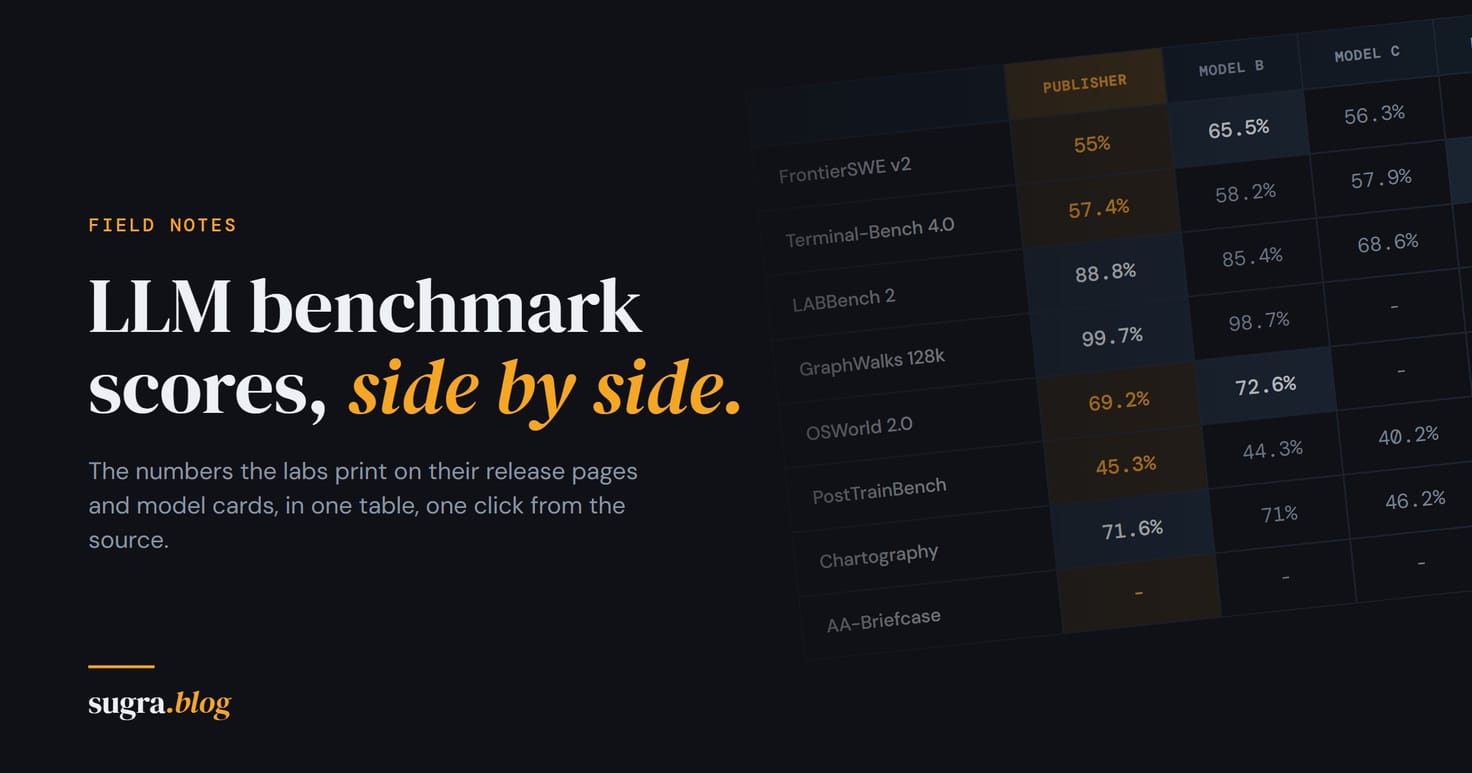
A launch page is a table with the publisher’s model in the first column. I kept the tables and lost the first column.
The table behind every model launch
Most model releases arrive with a comparison table: benchmarks down the side, models across the top, and the publisher’s newest model in the first column. The numbers are useful, but the tables are difficult to compare. Each release chooses a different set of models, tests, tools and evaluation settings, and each new launch makes the previous table look old.
I read these tables for work. We run models every day at Sugra Systems, and choosing one for a task often begins with what its developer says it can do. I started recording those numbers together with their sources and stated conditions. That record became the catalog below.
What this catalog is
The catalog contains results published by model developers on their release pages and model cards, and the API prices from their official pricing pages. Two independent evaluators run the models themselves, and their numbers are marked with their names. Vals AI printed what one coding task cost, the highlighted last row of the Price area, which a price per million tokens cannot show. Epoch AI fills a cell of GPQA Diamond, FrontierMath or SimpleQA Verified only where the developer printed no number for its newest model; OpenAI commissioned FrontierMath and has access to most of its problems. Sugra does not run these evaluations. Each value is stored as printed, in its original unit, with the source, date and conditions disclosed by the publisher.
Results remain attached to their publications. Two values in the same row may come from different harnesses, reasoning settings or tool policies; placing them side by side does not turn them into a single controlled experiment. Different benchmark versions and metrics remain separate.
There is no overall score and no ranking. The table is a sourced catalog of published claims: a place to see what was reported, compare the available evidence and open the original source before drawing a conclusion.
| Area | Benchmark | OpenAIGPT-6 Astra | AnthropicClaude Fable 5.1 | AnthropicClaude Opus 5.5 | GoogleGemini 4 Carbon | xAIGrok 4.7 |
|---|---|---|---|---|---|---|
| Model | Released | 2026-09-03 | 2026-09-01 | 2026-09-22 | 2026-10-28 | 2026-09-21 |
| Context window | - | |||||
| Max output | - | - | ||||
| Input | - | |||||
| Output | - | |||||
| Weights | - | |||||
| Knowledge Work | AutomationBench | - | ||||
| Harvey's Legal Agent Benchmark | - | |||||
| GDPval-AA v2.1 | - | |||||
| Agentic Coding | Terminal-Bench 4.0 | |||||
| FrontierSWE v2 | ||||||
| DeepSWE v1.1 | - | |||||
| ML Engineering | PostTrainBench v1.1via Google | - | - | |||
| Science and Math | GPQA Diamond | - | ||||
| Terminal-Bench Science 0.1 | - | |||||
| RiemannBenchvia Google | - | |||||
| Long Context | GraphWalks BFS 256k to 1M (F1)via Google | - | ||||
| Computer Use | OSWorld 2.1 offline subset | - | ||||
| Multimodal Understanding | Chartography (no tools) | - | ||||
| CharXiv Reasoning (no tools)via Moonshot AI | - | - | ||||
| MMMU-Provia Moonshot AI | - | - | ||||
| Cybersecurity | CWE-bench v1via Google | |||||
| ExploitGym | - | |||||
| ExploitBench | - | - | ||||
| General Knowledge and Reasoning | Humanity's Last Exam (no tools) | - | - | |||
| SimpleQA Verifiedvia Epoch AI | - | - | ||||
| Tool Use and Workflows | Agents' Last Exam v1.1 (score)via Google | - | - | |||
| Web Search and Research | BrowseComp | - | - | - | ||
| Healthcare | HealthBench Professional | - | ||||
| HealthBench | - | - | ||||
| Biosecurity | BioSecBench Functionvia xAI | - | - | - | ||
| Safety and Alignment | Gray Swan IPIattack success rate after k attempts, lower is better | - | ||||
| Engineering and Design | Blueprint-Bench 2 (normalized score)via Google | - | ||||
| BenchCAD | - | - | ||||
| EEBench rewardvia xAI | - | - | ||||
| Preference and Composite Rankings | Artificial Analysis Intelligence Index v5.0via Google | - | ||||
| Price | InputUSD per 1M tokens, lower is better | |||||
| OutputUSD per 1M tokens, lower is better | ||||||
| Cost per taskVals AI, USD, lower is better | - |
The Model rows are what each developer prints on its own model page; a dash there means it prints none. Each number is as printed, by the model's own developer where it published one; a number another company printed is marked via and its name. A price is the developer's API list price in US dollars per million tokens. Cost per task is measured by Vals AI. A number marked via Epoch AI is its own run, shown only where the developer printed none; Epoch AI data is CC BY 4.0. Click a value to see its source and stated conditions. A range means the page printed the model under several setups, and the click lists each. A dash means that no cataloged publication reported a result for that model; on a price row, that the developer lists that price in another unit or currency.
The areas
Benchmarks are grouped by the kind of work they test. The areas below are the catalog’s own; their descriptions are copied here from it.
| Area | What it covers |
|---|---|
| Knowledge Work | Tasks a professional is paid for: legal analysis, finance and tax questions, office documents, spreadsheets, research memos and other desk work. The tests here hand the model a realistic brief and judge the finished product, often with a human expert or an expert-written rubric. |
| Agentic Coding | Changing and repairing real programs. The model works inside a repository or a terminal over many steps, reads the code, runs commands, and is scored on whether the resulting change passes hidden tests or a reviewer. This is the busiest area on every launch page. |
| ML Engineering | Training and improving models rather than ordinary software: reproducing a research paper, running an experiment, tuning a training recipe, writing a compute kernel. The score is usually whether the resulting artifact works or reaches a target. |
| Science and Math | Mathematics from contest problems to research-level questions, plus scientific reasoning and laboratory knowledge in chemistry, physics and biology. Dangerous biological capabilities are kept out of this area and sit under Biosecurity. |
| Long Context | Finding, matching and using information spread across very long inputs: hundreds of thousands or a million tokens of documents, transcripts or structured data. The tests plant facts or relationships deep in the input and check whether the model can still use them. |
| Computer Use | Operating a computer the way a person does: a desktop, a browser, a mobile device, through screenshots and clicks rather than an API. Tasks are everyday chores in real applications, scored on whether the end state is correct. Open-ended web research has its own area. |
| Multimodal Understanding | Images, charts, video, audio, scanned documents and sheet music, and reasoning that connects them with text. The model has to read what it sees or hears and answer about it. |
| Cybersecurity | Finding and fixing vulnerabilities, reproducing known flaws in controlled test environments, analysing binaries and operating production systems under failure. These tests measure capability in a sandbox; the Safety and Alignment area measures whether the model refuses to misuse it. |
| General Knowledge and Reasoning | Broad knowledge, logic and abstract problem solving, factual accuracy and the mixed question sets that try to cover everything at once. The benchmarks here are the ones most often quoted as a single headline number. |
| Code Generation | Writing code from a specification without a long agentic process: a function, a component, a drawing, an algorithm. Scored by tests, by rendering the output, or by a judge comparing candidates. |
| Tool Use and Workflows | Calling functions and APIs, chaining tools, planning multi-step work and carrying a long task to the end. The environments range from office automation to games, and the score is whether the whole workflow completed. |
| Web Search and Research | Finding hard-to-locate facts on the open web and synthesizing an answer from many pages. The questions are built so that no single page answers them. |
| Instruction Following | Obeying constraints: output formats, length limits, data schemas, forbidden words and multi-step user requirements. The score is how many constraints the answer honored. |
| Multilingual | Knowledge and task performance across natural languages other than English: translation, multilingual question sets and regional exams. |
| Writing and Conversation | Creative and editorial writing, style, role play, and the emotional and social quality of a conversation. |
| Healthcare | Clinical and medical knowledge, medical documents, and the quality and safety of help given in a medical conversation, usually graded against rubrics written by physicians. |
| Biosecurity | Tests of dangerous biological capability and of dual-use risk: virology know-how, wet-lab troubleshooting, and whether the model refuses requests that could help build a weapon. Some sets also cover chemical and cyber risk. Here a high capability score is not good news, and the refusal scores are the ones to read. |
| Safety and Alignment | Refusals of harmful requests, resistance to jailbreaks, honesty under pressure, sycophancy, and whether an agent discloses its own failures or takes forbidden shortcuts. Most of these are rates where lower is better; the table says so on each row. |
| Engineering and Design | CAD modeling, electrical engineering, spatial design and the production of engineering artifacts from a specification, scored on whether the artifact meets the spec. |
| Preference and Composite Rankings | Head-to-head preference rankings by people or judge models, and composite indexes that average many unrelated tests into one number. A specialized index stays in its own area; only the catch-all ones live here. |
| Price | Not a test: what the developer charges through its API, in US dollars per one million tokens, as printed on its own pricing page on the day it was checked. One row per price component (input, cached input, cache write, output) and per schedule: standard, and the developer's others such as batch, flex, fast and priority. Lower is better. A long-context, regional or non-dollar price stays on the pricing page the value links to. |
The benchmarks, one by one
Each benchmark in the current view is described below: who maintains it, what it tests and which cataloged publications reported a result for it.
Knowledge WorkBack to table
AutomationBench tests whether AI agents can carry out business workflows that span several software applications, such as a CRM, an inbox, a calendar and a messaging tool, through their REST APIs. The agent has to find the right endpoints on its own, follow layered business rules, and ignore misleading records along the way. Grading is programmatic: the final state of the simulated systems is checked against success criteria, so a run is judged on the end result.
GDPval-AA is Artificial Analysis's version of OpenAI's GDPval, a set of realistic work tasks drawn from 44 occupations in nine major industries. Models get shell access and web browsing in an agent loop and produce a work product, and the outputs are compared in blind pairwise judgments that are turned into Elo ratings. The v2 revision re-anchors the scale so that human-expert deliverables sit near 1000 points.
Harvey's Legal Agent Benchmark tests AI agents on long, multi-step legal work. Each task gives the agent a short instruction and a client matter with case files, and asks for a work product that a reviewing lawyer would check, across more than 1,200 tasks in 24 legal practice areas. Expert-written rubrics grade each deliverable, and a task counts as passed only when every criterion passes.
Agentic CodingBack to table
DeepSWE tests whether coding agents can make original, long-horizon software engineering changes in real open-source repositories. It has 113 tasks across 91 repositories in TypeScript, Go, Python, JavaScript and Rust, all written from scratch so that solutions are not copied from existing commits. Hand-written verifiers check behavior through public interfaces, and each verifier runs three times to catch flakiness.
FrontierSWE tests coding agents on very long engineering and research jobs: reimplementing complex systems, speeding up existing code without breaking its correctness, and designing and training machine learning models on held-out data. Version 2 has 34 tasks, each with up to a 20-hour budget per trial. Results are averaged over five trials per task (mean at 5).
Terminal-Bench tests whether an AI agent can finish real jobs by typing commands into a Linux terminal, such as building software, configuring a system or processing files. Each task runs in its own sandboxed container, and the agent succeeds only if the final state of that container passes the task's automatic checks. Version 2.0 (November 2025) has 89 hand-checked tasks, and the companion Harbor framework runs the agents.
Vibe Code Bench tests whether an AI model can build a complete, working web application from a written description, starting from nothing. The benchmark has 100 app specifications split into validation and held-out test sets. An automated browser agent then checks each deployed app against 964 multi-step user workflows, and the score is the accuracy across their 10,131 steps.
ML EngineeringBack to table
PostTrainBench tests whether an AI agent can do post-training, the stage that turns a raw language model into a useful assistant. Each agent gets a small base model, one GPU and a 10-hour budget, and is free to pick data and methods to improve it on a target test. Scores compare the agent-trained model with the official instruction-tuned version, and the authors also track cheating such as training on test data.
Science and MathBack to table
GPQA is a set of 448 multiple-choice questions in biology, physics and chemistry, written by experts with or working toward PhDs in those fields. Domain experts reached about 65% accuracy, while skilled non-experts with web access reached about 34%, which is why the questions are described as hard to answer by search alone. The Diamond subset is a smaller, harder selection of these questions.
RiemannBench tests research-level mathematics that goes well beyond olympiad-style problems. It is a private set of expert-written problems, each with a unique closed-form answer that is checked by a program, and each problem is verified by two experts solving it independently. Models run as unconstrained research agents with coding tools and search, and are scored with a statistical estimator over many independent runs.
Terminal-Bench-Science tests AI agents on the computational workflows working scientists actually run, not textbook questions. Each task is a containerised terminal job, such as statistical analysis, simulation, signal processing or proofs, and the output is checked by task-specific automated tests. Version 0.1 has 70 tasks written by practising researchers across life, physical, Earth, mathematical and engineering sciences.
Long ContextBack to table
GraphWalks gives a model a directed graph as a long edge list and asks one graph question in a single answer, with no tools. The two task types are a breadth-first search from a start node to a given depth, which returns only the nodes at exactly that depth, and a parents query, which returns the nodes with an edge pointing into a given node. The public dataset has 1,150 examples, split into inputs of 128k and shorter and inputs from 256k to 1M. Each answer ends with a 'Final Answer:' line of node IDs and is scored by recall, precision and F1 against the true set.
Computer UseBack to table
OSWorld tests whether an AI agent can carry out open-ended tasks on a real computer desktop, on Ubuntu, Windows or macOS, by clicking and typing in real applications. OSWorld 2.0 has 108 long workflows across professional and everyday work, each taking a skilled human over an hour, with some changing mid-task and some requiring questions to the user. Success is binary completion within a 500-step limit, with a partial score for checkpoints reached.
Multimodal UnderstandingBack to table
Chartography tests whether AI models can read and reason about professional charts, such as Kaplan-Meier survival curves, candlestick charts, Sankey diagrams and Bode plots, which standard chart tests rarely include. It has 100 tasks written by professionals in fields such as medicine, engineering, finance and manufacturing. Numeric answers are checked against ranges set by the expert author, and scores are averaged over repeated runs.
CharXiv tests whether a multimodal model can read real scientific charts. The set holds 2,323 charts taken from arXiv papers, each with descriptive questions about basic chart elements and reasoning questions that need information synthesized across the chart. All charts and questions were hand-picked and verified by human experts. The reasoning split, the one model cards report, is scored as accuracy on the reasoning questions.
MMMU-Pro tests whether a multimodal model still understands multi-discipline questions once the shortcuts of the original MMMU are removed. The benchmark was built in three steps: questions that text-only models could answer were filtered out, the candidate options were increased from four to ten, and a vision-only setting embeds the whole question inside an image. The paper reports 1,730 questions, and the overall score is the average of the ten-option standard setting and the vision-only setting, with model answers read from an 'Answer: $LETTER' line.
CybersecurityBack to table
CWE-Bench evaluates coding agents on defensive security work. Each task gives the agent a checkout of a real open-source repository, sometimes with disclosed CVEs reproduced in it, and asks it to audit the code and fix what it finds without being told how many vulnerabilities there are. A fix counts only if the exploit is blocked and the existing tests still pass, with no partial credit, and agents are not asked to write exploits. The page reports 100 held-out tasks in v0 and 120 in v1.
ExploitBench measures how far an AI agent gets along a ladder of 16 checkable capability steps when it works on known, already-patched bugs in the V8 JavaScript engine used by Chromium. The steps run from triggering the bug up to full control of the target, and each step is confirmed by an automatic verifier with no AI judge. The public set has 41 bugs, all reported in 2024 or later.
ExploitGym measures whether AI agents can take a program input that already triggers a software vulnerability and turn it step by step into a working attack. The benchmark has 898 instances in three areas: ordinary user programs, a JavaScript engine, and the Linux kernel. Protections are varied from task to task to see how they change agent success, and every task runs in a reproducible container.
General Knowledge and ReasoningBack to table
Humanity's Last Exam is a test of about 2,500 expert-level questions across dozens of subjects, including mathematics, the humanities and the natural sciences. The items are multiple-choice or short-answer, so answers can be graded automatically. It was built because leading models had passed more than 90 percent of older tests, and at launch the most capable models scored below 10 percent.
SimpleQA Verified is a cleaned 1,000-question version of SimpleQA, with mislabeled answers, duplicates and topic imbalance fixed. An automated grader marks each answer, and the paper reports an F1 score; model cards usually print accuracy or pass@1.
Tool Use and WorkflowsBack to table
Agents' Last Exam tests AI agents on long, realistic professional tasks with checkable outcomes, covering 55 sub-industries of the non-physical economy. Agents get only a task description and work in full operating-system sandboxes, and outputs are graded against hidden, deterministic reference answers. The public release (ALE-V1) has 147 tasks drawn from a larger corpus of more than 1,500.
Web Search and ResearchBack to table
BrowseComp tests whether an AI agent with web browsing can find hard-to-locate facts that are spread across many sources and tied together. It has 1,266 questions with short answers that are easy to check against a reference. Models without browsing scored near zero when it was released, and a browsing agent solved about half of the questions.
HealthcareBack to table
HealthBench tests how well an AI model answers health conversations, such as those with patients or clinicians, judged against detailed rubrics written by physicians. It has 5,000 multi-turn conversations and 48,562 rubric criteria, each with a weight that reflects how much a physician would value it. An automatic grader scores each reply against the rubric, and the benchmark includes subsets named Consensus and Hard.
HealthBench Professional tests AI models on real conversations that clinicians had with an AI assistant, in three areas: care consultation, writing and documentation, and medical research. Each example is scored against rubrics written and checked by at least three physicians. It is meant to be hard, and about a third of the examples were chosen because physicians deliberately tried to find failures.
BiosecurityBack to table
BioSecBench is a family of three checkable tests from LatchBio for AI agents doing biology work with a biosecurity angle. The Refusal part pairs routine research tasks with tasks that look like research but hide a hazard, and measures how often an agent refuses. The Surveillance part checks whether an agent can run pathogen genomic surveillance analyses correctly, and the Function part checks whether an agent can infer biological function from experimental data, scored against ground truth.
Safety and AlignmentBack to table
Probability that an attacker finds a successful indirect prompt injection after k attempts, across coding, tool use and GUI computer use.
Not checked against a maintainer's page.
Engineering and DesignBack to table
BenchCAD is a benchmark of 17,900 industrial CAD programs written in CadQuery, each checked by running it, across 106 part families such as gears, springs and drill bits. Models answer questions about drawings and code, turn an image into code, and edit code according to an instruction. The authors report that current models often capture the rough outer shape of a part but struggle to build faithful parametric programs.
Blueprint-Bench tests spatial reasoning by asking a model to turn photographs of an apartment into a two-dimensional floor plan. The plan is scored against the true one by comparing which rooms connect and how their sizes rank. Blueprint-Bench 2 is the agent-only version: an agent works through 50 apartments in sequence and keeps a notepad between them, and its score is normalized so that a random plan scores 0 and a perfect one scores 1.
EEBench is an agent benchmark for electrical and hardware engineering, aimed at the requirements, design and test loop of a hardware project. Agents submit atopile design bundles, and the harness builds the circuit graph, bill of materials and simulation decks from that source. Each requirement is checked by simulation at worst-case component-tolerance corners, and the leaderboard score blends engineering results at 65% with cost efficiency at 35% against a reference bill of materials. The held-out tasks are not published.
Preference and Composite RankingsBack to table
The Artificial Analysis Intelligence Index combines several test suites of primarily text-based, English-language tasks into one score for a language model. Its methodology page groups the evaluations into agents, coding, general knowledge and scientific reasoning, with a weight for each. The score is a weighted average, and agent tests are converted from Elo ratings to a 0 to 1 contribution.
PriceBack to table
Not a test: the price the developer charges through its API, in US dollars per one million tokens, as printed on its pricing page on the day it was checked. Input is the prompt, cached input a prompt prefix served from the cache, cache write the cost of storing that prefix, output the reply including any thinking tokens. Standard is the regular rate; batch, flex, fast and priority are the developer's other schedules. A price for long context, for a region or in another currency is on the pricing page the value links to. Lower is better.
How the catalog is maintained
The catalog is a public repository, sugra-llm-benchmarks, and this page reads a copy of the file it builds, refreshed when the article is updated; the data version and its date are printed under the table. It is a maintained record, not a scraper: new release pages and model cards are read by hand, because the details that matter often live in headings, footnotes and evaluation notes, such as the benchmark version, the reasoning effort or the tool policy behind a number. Values are added as printed and checked against the repository’s data contract, and a correction never replaces the past silently: the new record supersedes the earlier one, which stays in the history.
The catalog shows what model developers published. It does not say which model is best for your workload, and it does not replace independent evaluation or a test on your own tasks. If a value here differs from the source it cites, the source is right; open the value and press Report an error, which opens an issue in the repository with the record filled in, so the catalog can be corrected. Copy citation next to it gives the value with its source and the data version in one line. The models and the leading scores will keep changing, and the rules of the catalog should not. Writing a number down with its source is what lets an old number remain an honest record.